Showing posts with label culture. Show all posts

Sunday, August 2, 2026

For Endurance, Capture The Culture

     The remarkable Haretina Kukuri has produced a stunner of an essay about the longevity of the world’s oldest continuously functioning institution, the Catholic Church. She covers many elements of the Church’s structure and positioning in the lives of its adherents. Some of them will strike the reader as “of course” matters, while others display a penetration that prior analysts of the Church have failed to exhibit. A brief taste:

     The Church did not build an organisation. It built a civilisation and then took up residence inside it. A calendar organising the year. An architecture dominating every European skyline. A visual grammar that generated most of Western art. A vocabulary that shaped Western law, ethics and political language. A ritual marking birth, marriage and death for the majority of people who have ever lived in the West. Vestments, polyphony, incense, and a dead language retained precisely because a dead language cannot drift.
     Above all, a claim about time. A cathedral is a promise made by people who knew they would be dust before the roof closed, financed by towns that could not afford it, carved by masons whose names are lost to everyone but God. Every stone argues that the future is real and that we owe something to people we shall never meet.
     That is the actual technology. A company may be copied within a year. A culture cannot be copied at all, because it is not a set of practices but a set of practices plus the centuries that rendered them inevitable.

     The extraordinary endurance of that civilization is often overlooked by secular observers. Some would rather ignore it; others gaze upon it in bafflement. Haretina captures the totality of it better than anyone else has done.

     I lived in that civilization. When I take a moment to remember it in detail, I realize how badly I miss it.

* * *

     Long ago, in remembrance of my childhood community, I wrote:

     It was an overwhelmingly Catholic community. There were five Masses each Sunday morning, and all of them were attended to capacity and beyond. The parish priests were regarded as higher authorities than any elected functionary. When our pastor was elevated to Monsignor, we young ones were stunned that the town didn't hold a parade.

     Most of the children attended the parish's grammar school, St. Catherine of Alexandria. Despite St. Catherine's huge class sizes -- classes of fifty were the norm -- standards were high, and the pressure to get in never slackened. The local public grammar school was regarded as a refuge for the children of lazy parents, who didn't care how their kids were taught; it had many unoccupied desks. Competition among the latter-grade students at St. Catherine's was intense; we all wanted to go to the local Catholic high school, Albertus Magnus, and we knew there weren't places enough for all of us.

     “Catholic community” has the sense of a unitary noun. The Catholicism could not be separated from the community. In that town, the civil authorities deferred to the parish pastor. Indeed, every home there was filled with crucifixes, votive candles, saints' images, and so forth. When the time came for prayer, a visitor was expected to pray with his hosts. Catholicism was the culture. When a Jewish family moved in, no one quite knew what to do!

     This parallels Haretina’s previous essay about the strength and invulnerability of the Mafia culture. When an institution marries itself to the culture of a place so intimately that it can no longer be separated from the life of that place, it has acquired a longevity that secular institutions cannot equal.

* * *

     The question on my mind this morning is whether it remains possible for a new institution to achieve a similar degree of cultural capture. Religions will always have a large advantage over secular institutions in that regard. In the nations of Europe, the Church has been losing its grip on the allegiance of the people, despite the many markers of its legacy. But other potential cultural appropriators, despite prodigious efforts, have failed to establish themselves with the same degree of firmness. Why?

     Because the culture remains Catholic, even in those places where conscious faith and explicit worship have faded away.

     Europe is under siege by the tides of migrants from North Africa and the Middle East. Yet these, however numerous and motivated, have not succeeded in insinuating themselves into the culture and practices of the Old World. I predict that they will not. They’re up against a more powerful, more integrated, more satisfying culture than what they’re striving to impose. Their efforts just might stimulate the resurrection and revitalization of what was once called Christendom.

     America, originally settled largely by Protestants, developed differently. Catholic culture arrived in quantity mainly after the Civil War. It took hold in districts that were predominantly peopled by immigrants from the persistently Catholic parts of Europe. And where it did, it was strong, as I mentioned above. But it didn’t become the national culture; the orientations and practices of the Protestant sects that preceded it had and have their own grip, not to be easily contested nor displaced.

     Yet American Catholicism, if slightly at variance from the European variety, is strong and vital. Catholics amount to a quarter of the national population. A great many “cradle Catholics” who drifted from the Church are returning as the years mount upon them. I was one, and I’ve met several others. It’s common among converts, especially converts from Protestant sects, to embrace Catholic culture completely: the crucifixes, the statues and holy images, the votive candles, the great feast days, the wall sconces for holy water, the ritual prayers, and the other practices promulgated and encouraged by the Church. The culture is as important to them as the faith itself. That culture shields its adherents against a multitude of invasions and infections.

     Culture is powerful. Catholics know it. Draw the moral.

Sunday, December 7, 2025

Rootlessness

     First, some thematic music:

Now it's been 25 years or more
I've roamed this land from shore to shore
From Tyne to Tamar, Severn to Thames
From moor to vale, from peak to fen
Played in cafes and pubs and bars
I've stood in the street with my old guitar
But I'd be richer than all the rest
If I had a pound for each request
For "Dueling Banjos," "American Pie"
It's enough to make you cry
"Rule Britannia" or "Swing Low"
Are they the only songs the English know?

Seed, bud, flower, fruit
They're never gonna grow without their roots
Branch, stem, shoots
They need roots

After the speeches when the cake's been cut
The disco's over and the bar is shut
At christening, birthday, wedding or wake
What can we sing until the morning breaks?
When the Indian, Asian, Afro, Celt
It's in their blood below the belt
They're playing and dancing all night long
So what have they got right that we've got wrong?

Seed, bud, flower, fruit
Never gonna grow without their roots
Branch, stem, shoots
We need roots

And haul away boys, let them go
Out in the wind and the rain and snow
We've lost more than we'll ever know
'Round the rocky shores of England
Haul away boys, let them go
Out in the wind and the rain and snow
We've lost more than we'll ever know
'Round the rocky shores of England

We need roots
We need roots

Now the minister said his vision of hell
Is three folk singers in a pub near Wells
Well I've got a vision of urban sprawl
It's pubs where no one ever sings at all
And everyone stares at a great big screen
Overpaid soccer stars, prancing teams
Australian soap, American rap
Estuary English, baseball caps
And we'd all be ashamed before we'd walk
Of the way we look and the way we talk
Without our stories or our songs
How will we know where we come from?
I've lost St. George and the Union Jack
That's my flag too and I want it back

Seed, bud, flower, fruit
Never gonna grow without their roots
Branch, stem, shoots
We need roots

And haul away boys, let them go
Out in the wind and the rain and snow
We've lost more than we'll ever know
'Round the rocky shores of England
Haul away boys, let them go...

     [With thanks to Tom Kratman, who first exposed me to this quintessentially English song.]

     I’d guess that most people alive today don’t think much about their roots. Indeed, they might reject the concept, at least if it applies to anything beyond their own families. But there was a time when the traditional concept of roots as including one’s neighborhood, its institutions, and the ethnocultural commonalities that dominated there was widely recognized and honored. That time, in these United States, ended with World War II, if not earlier.

     Several questions arise at this point:

  • Did that concept have value?
  • Did it have religious or occupational facets?
  • What baggage did it carry that we’re better off without?
  • Can one remain “faithful” to one’s roots after moving a significant distance away?
  • What influences other than geographic displacement can weaken one’s attachment to his roots?

     Those are difficult questions for a Twenty-First Century American to face. They demand a sober look at ourselves and what made us who we are. Europeans face them somewhat more equably, because of the obvious differences among the nations of the Old World, even those near to one another. There’s specific ethnocultural meaning in claims such as “I’m English, “I’m French,” or “I’m German.”

     The song above says strongly that an Englishman should know and honor his roots. That comes close to blasphemy today, with the U.K. having filled up with persons no one would associate with the England of 1940. The multiculturalist gospel condemns such allegiances.

     But what if we need them? Is rootlessness a special kind of vulnerability? Something that attracts predators, perhaps? What if one cannot live a decent life – one that satisfies levels two and three of Maslow’s Hierarchy — without an awareness of one’s roots and their value?

     I need to ponder this awhile before I can continue. However, you, Gentle Reader, are invited to post your thoughts as comments here. When I return to this topic, I’ll make use of them, with proper attributions.

Thursday, June 6, 2019

The Cultural Front In The Identity Wars

     “Shucks,” Duke told them, “didn’t you know? The boss likes statues.”
     “Really?” Jill answered. “I don’t see any sculpture around.”
     “The stuff he likes mostly isn’t for sale. He says the crud they make nowadays looks like disaster in a junk yard and any idiot with a blow torch and astigmatism calls himself a sculptor.”

     [Robert A. Heinlein, Stranger in a Strange Land ]

     I listen to a great deal of music, from a wide variety of genres and styles. Many a Gentle Reader would find it odd that I enjoy Chopin, Bach, Beethoven, Gershwin, Prokofiev’s concerti, Stravinski’s major works, the early Rolling Stones, Bob Dylan, Dave Grusin, Diana Krall, Tony Bennett, Emerson Lake & Palmer, Gordon Lightfoot, Tom Rush, Loreena McKennitt, Andreas Vollenweider, Led Zeppelin, the Mothers of Invention, Glass Hammer, Donna Summer, modern “trance” – thanks a lot, Dystopic / Thales! — and 2Cellos’ and the Harp Twins’ covers of AC / DC and Guns’N’Roses hits. Still, that’s the reality. I have my favorites, of course, but I exclude very few musical genres as such.

     (Don’t mention Schönberg, Philip Glass, or John Cage if you want to stay friends. There are limits.)

     What I find most appealing in music is the sense of order it conveys. The composition itself needn’t be entirely pleasing to the ear as long as I can find order and thematic unity in it. Stravinski’s “Rite of Spring” is at many points dissonant, but it’s an exalting piece to listen to because of the conceptual unity it expresses. Classical music is almost entirely about the development of such order. Bach is probably the best known expositor of a meticulous, almost mathematical approach to such development, but it’s characteristic of all the great European composers of that era.

     Order and discipline are features of all the great art and artists of pre-World Wars Europe. Classical-era artists of every sort found the rules that defined their chosen art form a challenge to be met rather than fetters to be broken. The lawless, chaotic “art” that characterized the century behind us grew from the senselessness of its many internecine struggles: military, economic, cultural, and social.

     The decline of “artists” willing to accept the disciplines of classical art forms correlates well with the loss of other social norms such as public peace and civility. Cause or effect? Your Curmudgeon reports; you decide.


     Brett Stevens has an idea:

     It turns out that blasting classical music at outsiders alienates them and induces them to vacate the premises:
     Classical music is being played at Hull’s railway station in a bid to reduce anti-social behaviour. The company said that the same move at Cleethorpes station had seen “complaints of anti-social behaviour reduced by around 75%”. “We probably used to have about 20 to 25 youths on the station each night and now we’d be lucky to get two or three.”
They react to the strong signal of Western European style order and balance. It also makes it clear that this is not a space for them, but for us.

     Delightful! I had no idea it could be that simple. Of course, there was always the possibility that the miscreants would turn on the “offending” establishment and trash it, but apparently that hasn’t happened. And apparently – much to the displeasure of the multiculturalists – it also works here in the U.S.:

     Indeed, playing classical music to clear out public spaces is an act of supreme elitism: an attempt to “civilize” a space by making it unpleasant to people whose tastes differ from your own.

     Early attempts in this direction date to the mid-1980s, when a 7-Eleven began playing music in the parking lot as a deterrent to the crowds of teenagers congregating there. Plenty of stores continue to use the technique, and other examples have been cropping up sporadically ever since. In 2001, police in West Palm Beach, Fla., blasted Mozart and Beethoven on a crime-ridden street corner and saw incidents dwindle dramatically. In 2010, the transit authority in Portland, Ore., began playing classical music at light-rail stops, and calls to police dropped.

     I love it – and not just because of the music.


     I’m going to repeat a story you may have seen here before. It’s not about music but about order: the sense of a necessary pattern that must be observed for something to “make sense.”

     On the way back from another errand I’d stopped at a local shopping center for something or other. As I parked I spied a knot of teenagers congregated in front of the strip mall. One of them was eating handfuls of something from a plastic bag. As I debarked he dropped the empty bag on the sidewalk, though there was a garbage can less than six feet away.

     Being a terrible martinet and a scold of the first water, I said nothing. I merely walked up to the young litterer, stooped, grabbed his trash and stuffed it into the garbage can with emphasis, glaring at him all the while. Now, I’m not large – about 5’7”, 160 lb – and this young ruffian towered over me. But his face turned as white as if I’d leveled a gun at him.

     “I was going to do that,” he stammered.

     I shook my head and entered the store. The clerk, who had witnessed the event, said plaintively that what I had done was “very brave.”

     Why did she say that? What I did wasn’t brave at all. The kid couldn’t have hurt me, though he didn’t know that. What he did know was what he saw: I had asserted a rule of public order that he knew about but had casually flouted. Perhaps no one in his experience had ever done such a thing. That someone had dared to assert that rule visibly struck terror into him.

     That young man was white, and probably of European descent. In all probability his upbringing had included admonitions not to litter or deface public places. But his cultural identity was one that celebrates the flouting of the rules of public order as I – and likely he – had learned them.

     Order reasserted in the face of flagrant disorder is terrifying to the agents of chaos.


     As with a wide variety of musical tastes, there are limits. We can’t demand that all men go about in suits and ties any longer, nor that all women dress as modestly as urban American women did in the Fifties. But we can impose a perimeter on public deportment, and one of the instruments available to us is great traditional European art, especially music. It’s less about “driving the invaders away” than about enforcing tolerable norms in public spaces.

     Not to mention that substituting Chopin for the mind-numbing crap that assaults one’s ears in most retail establishments would bring a tremendous improvement to commercial civility, n’est-ce pas?

Wednesday, April 4, 2018

Having Fun Watching Liberal Heads Explode!

I saw this story about the ratings of the new Roseanne show. As it happened, I did watch the re-boot. My husband suggested it, and I agreed. I didn't expect much, as a once promising show dwindled into un-funny after a few seasons previously.

I liked it. Yes, it presented some Liberal concepts. It did so, fairly, showing BOTH sides to have some flaws.

The part about the cross-dressing kid:

  • He's being raised by a single mom, whose marriage fell apart, and who recently lost her job and home. She is devastated by her failures.
  • He very definitely says he is a boy. He is comfortable with his fashion choices.
  • Dan is opposed to his wearing the clothing outside of the house, as he believes that it will lead to his grandson not having friends. However, when the boy responds that he understands that, but he wants to dress how he wants, Dan is supportive.
  • He does get teased. He does not, at that point, have any friends. His mother is upset, but points out that it's because he is weird, like the rest of the family. They laugh, and accept that his choice will cause some short-term pain, but he is willing to stick to his guns.
Roseanne's sister Jackie is - as always - spouting the Liberal Line verbatim. She is written, and played, as an unthinking follower, whereas Roseanne is shown to be one who thinks for herself. Quite a fresh idea!

The other sister, Becky, is planning to be a surrogate for an infertile upper-class Progress twit. She quite frankly admits that she is doing it for the money. Both parents are unhappy with her choice. They try to talk her out of it, using quite standard Conservative arguments, but are unsuccessful.

Roseanne is resigned to Becky's decision, and, in an apparent appeal to Libertarian thinking, says that it is her choice.

BTW, the kid-buying twit is held up for some much-deserved ridicule. The actress plays her straight; she portrays the worst example of a woman buying a kid to fulfill her agenda.

I can't describe what made it so funny. It reminded me of Last Man Standing, which also skewered Liberal thought by presenting opposition to it by someone who was NOT a Puritan, Hypocrite, or Religious Nut.

It was refreshing.

Another Media Moment to Cause Exploding Heads?

Chappaquiddick is due to be released next week, April 6 (Friday). This will NOT play out well in these #MeToo days. I'm old enough to remember the 'investigation', although I was distracted by the Moon Landing that same weekend. Can't wait to see what a true examination of that death will be.

Wednesday, November 15, 2017

Savonarola and His Offspring

Girolamo Savonarola was a Dominican friar during the Renaissance. He preached against church corruption, the Medicis, and secular art, among other things. His commission of secular books and art to flames became known as the "Bonfire of the Vanities".

Eventually, he ended where many reformers who take on powerful forces end - in death. He was excommunicated and hung, along with several of his friars. The purification movement petered out.

Periodically, similar manias flare up again. They are generally focused on purification of a society of worldly influences, sins, and corruption. They aim to bring about changes that will help the poor. The leaders take on those who they judge to be despots, and work to encourage the people to revolt against their rule.

There have been many manias since:

  • The Salem Witch Trials - used quasi-legal means to attack those in power, who were accused of working with the Devil
  • The French Revolution - different from the American Revolution, which aimed to establish independence from their colonial rulers, but a true frenzied tearing down of all "corrupt" elements in that society. All of the royal family and most of the nobility were accused of crimes against the people. A rumor could spark the mania to flare up again, and entangle yet another person or family in accusations, which would end in confiscation of property and eventual death by guillotine.
  • The Civil War - I contend that the post-Transcendentalists who lead the Abolition movement were motivated largely by their desire to "purify" America of sin. On the other side, the frenzy was based in Charleston, SC, where the most fervent and rabid secessionists had their base. On both sides, largely a war that pitted those that wanted a country free from slavery (sin), and those that wanted a country free of unconstitutional modifications (sin). [NOTE: both the Carolinas gave a disproportionate number of their citizens to the War for Independence - their children and grandchildren would have grown up hearing stories of how they had fought against tyranny (sin)]
The 60's were yet another example of mania that was based around the idea that America could be purified of its sins. The Weathermen and other radical groups just took this a mini-step further.

Since the Clinton Era, we've seen a permanent cadre of grant-subsidized fanatics who will stop at nothing to purify the USA, and rid it of perceived racism and sexism. To that end, they have initiated a war on individual freedom to start a business, to vote freely, to worship freely, to speak freely, to own a gun, to make decisions for their minor children, to publish anything that is contrary to Progressive Thought - in short, to act as free citizens in a society that they have some control over.


Wednesday, October 4, 2017

Mexico is No Longer a Country

It is isolated islands of the Elite, with good medicine, government services, education, and cultural amenities, protected by well-armed and well-paid militaries.

Surrounded by desperate poverty, anarcho-government, criminal enterprises, and little hope for the future.

In short, Mexico has re-invented Life in the Middle Ages. The Elites live in the Castle, the Serfs live in squalor on the countryside, exposed to many dangers from the roving hordes.

Read the story of how Mexico's Elites are compacting, withdrawing into smaller and more easily protected communities. 

One of the defenders of Mexican life is Fred on Everything. His description of Mexico is accurate, from the perspective of the Elite. Another of his posts comparing the US to Mexico.

In Mexico, as well as in America, the working classes had standards - they worked, they watched the behavior of their kids, they didn't sit around in a stupor waiting for a government check. In both places, too many are no longer living up to that ideal.

The behaviors of the non-Elite, together with government policies that reward those with money and encourage the further stratification of society, have killed the Nation-State ideal. Instead, we have deteriorated into Elite Islands carefully separated from the Rest of Us.

Friday, April 28, 2017

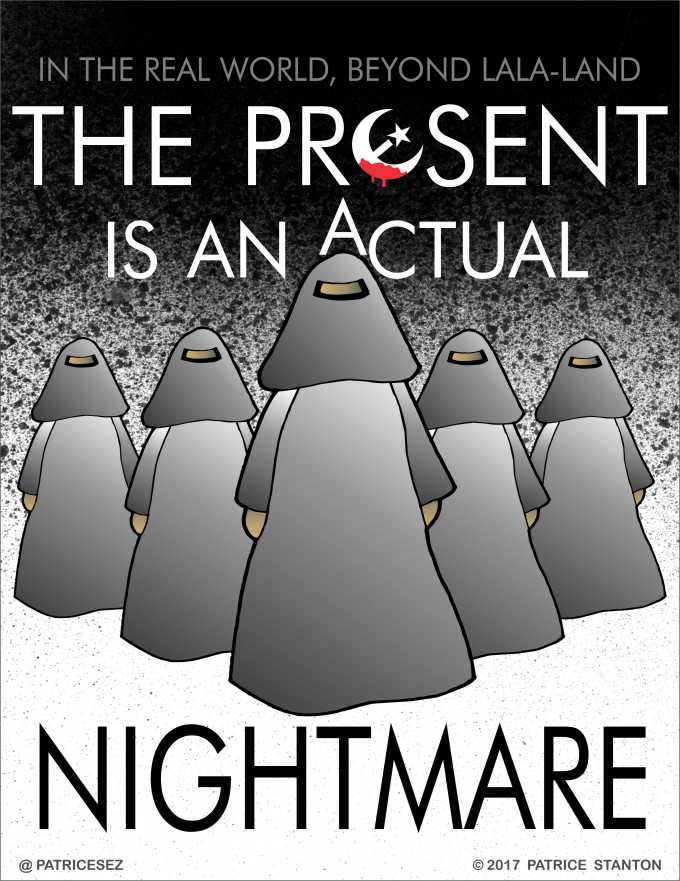
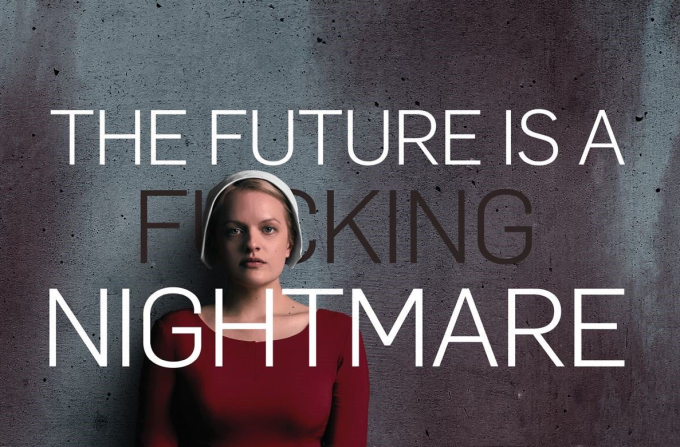
I watched "The Handmaid's Tale," so you wouldn't have to


HandmaidsParodyPoster


ActualHandmaidsPoster_Twitter.png


They missed the mark by "this much..."


If an editor had substituted an Islamic "call-to-prayer" for every tolling church-bell, a line from the Muslim-trifecta (Koran/Sunnah/Hadith) for every New Testament quote, and a head-to-fingertip-to-toe all black Islamic woman-shroud for the scarlet red Maids' robes, then I'd say Hulu has a winner with their 10-part cautionary, "The Handmaid's Tale." But as it stands? It's a Hate+Hit piece which slanders all Christians, but particularly Protestants (a cathedral is shown being demolished; a priest is among the regime's most hated, executed-by-hanging, next to an abortion doctor and a homosexual).

I took forteen (smallish-) pages of notes during the currently available three episodes, complete with hour-minute designations, just so I could go back and "perfect" the quotations. Honestly, though, I'm not sure I want to give that much thought to proving how stupid, misguided, and downright inciting-to-hatred-of-Christians this production and its "creatives" are. I think I'd rather put the effort into a more reality-based novella, addressing the problems of the very same sleep-walking Western feminists, who in "T.H.T.," wonder aloud, "How did we let it happen..."

I only shouted at the screen a few times, "Same way you're 'letting' Islamic supremacism happen, right now, you idiots!" They don't see it in the EU, so they sure as heck don't recognize it'll be on our horizon, next.

If only the creatives involved in the series (and the sure-to-be-legions of fans) had an ounce of shame, they could wake up before this nightmare scenario comes true via our Islamic "friends." They won't, because in 2017, as they did back after 1986's novel, and 1990's first screen production, they still actually expect Christians to go on a rampage nationwide, "stretching necks" and gouging out eyes and clitorises(sp?).

Because they refuse to look, they'll never see the caliphate coming.
Therefore, they will become the very characters they wrote or pretended to be.
("Nobody expects the Spanish Inquisition")


Thursday, April 27, 2017

Long March News

     By now I’m sure all my Gentle Readers have learned about the cancellation of Ann Coulter’s appearance at Berkeley, which was scheduled to occur today. In other Left Coast news, Portland, Oregon’s annual Parade of Roses was cancelled for the same reason. I’m certain we have only a few hours before a hue and cry arises over President Trump’s pledge to return K-through-12 education to state and local control. Instapundit readers will already know that graduate-student-union activists have attacked an internationally famous chemist as a “rape apologist.”

     So what else is new? Well, there’s a Liberty Zone tirade about the decline of trust in the news media, and Darin at Crusader Rabbit discusses why Fox News is moving leftward. I must admit, it disturbed me somewhat that in his new tenure over Bill O’Reilly’s vacated slot, Tucker Carlson (“He’s so cute!” – my wife) chose to interview Caitlyn Jenner as his first priority. But if Darin is correct, it’s all of a piece. Money talks, don’t y’know.

     There are the ongoing attempts to erase history. There’s the usual Islamic agitation for special privileges. There’s all the usual bashing of Christians, men, white people, and anyone else with too much pride to form their own special interest group. Keeping track of all this stuff is cutting into the time I need to purge my hate mail.

     A little more of this and we’ll have lost the culture, fellow freedom lovers. Maybe we already have.


     The emergence of citizen journalism, conducted mainly via the Web, seemed promising. The explosion of indie writers and filmmakers heartened me considerably. The homeschooling movement, coupled to the proliferation of school-choice initiatives, promised to bring important change. And of course, there were the talk-radio stations and Fox News. For a while, it looked as if we might break the culture free of the Left’s stranglehold.

     I’m not sure why it hasn’t happened. The Left isn’t good at journalism (it suppresses the most important news), entertainment (there are irritating leftist political messages embedded in everything), or education (our kids are coming out both stupid and deluded). Out-competing them seemed the way to go. If that’s correct, it’s taking far longer than I hoped. Worse, forces I’d have thought would favor freedom have proved by their behavior to be on the other side.

     The digital revolution, of course, was inherently apolitical. The facilities it created are available to all. Yet it’s we in the Right who’ve striven most determinedly to use them. So why aren’t we getting anywhere?

     Though significant and cheering in and of itself, it would be a grave mistake to overvalue the election of Donald Trump. Remember Andrew Breitbart’s adage: “Politics is downstream from culture.” Ultimately, the culture might prove to be the only battleground that matters.


     In contemplating this matter, I find myself wondering about the importance of communities: neighborhoods and voluntary assemblies such as churches, clubs, and charities. I’d guess that most people don’t think of them as cultural elements, yet they plainly are. Churches promulgate conceptions of morals, ethics, and what constitutes a life well lived. Clubs give emphasis to particular interests and pastimes, themselves important signposts of how we spend our free time. Charities, of course, actuate our fellow-feeling sentiments, which are critical to any view of what is best in life.

     (Do you think there were charity organizations among the Mongol hordes? Myself, I’d bet against it.)

     But Americans’ interest in all three of these things have fallen off. Churches have suffered political infiltration and a correlated decline in attendance at services. Clubs, especially men’s clubs, are waning as well, though the reasons aren’t quite as clear. And though Americans remain the most charitable people on Earth, we’ve been “contracting it out” – i.e., eschewing personal involvement in favor of writing a check to some large, supposedly charitable organization – ever more as time has passed.

     Whatever fraction of our culture is embedded in those institutions has weakened gravely. Nor is it clear how they might be resuscitated.


     “The news is all bad, but it’s good for a laugh.” – Tom Paxton

     Street violence is rising. Privacy and cash are under attack. Transgenderism has become a trend. Communists and left-wing identitarians are bidding to become the dominant voices -- indeed, the only voices -- in the national discourse. The Republican caucuses in Congress have preemptively surrendered to the minority Democrats. Even Donald Trump is retreating from the border wall. Perhaps worst of all, a small number of major institutions have secured effective control of the Internet. They’re fighting the repeal of one of the most pernicious developments of the Obamunist Era: net neutrality. Miraculously, none of them are governments...but give them time.

     Of all the pro-freedom initiatives of the past decades, only one – the right to keep and bear arms – seems to have achieved a net advance. We’ll see shortly whether that’s good news.

     Inasmuch as this is trending ever more depressing, while I have fiction to write and numerous chores of other sorts (don’t ask), I suppose I’ll close with a couple of relevant images:

     Have a nice day.

     UPDATE: Yes, so soon. I’ve already received an email about the above column. My correspondent wrote “Come on, give me an example of some really bad news.” Okay, you asked for it: One of my fellow parishioners tells me that her three children have adopted an exciting new game: racing the timer in their electric toothbrush. Truly, we are doomed.

Thursday, December 29, 2016

“Passengers,” A Few More Words

     ...and not about the movie.

     Way back when – years when I was too short to reach the stove – the opinions of celebrities on social, political, and economic issues didn’t matter to anyone except perhaps their families. Shortly after that – though I believe I was still too short to do the dishes – the television became a staple of the American household and the Cult of Celebrity was born. People whose talents for singing, dancing, joking, or otherwise entertaining us had become “evening guests” in our living rooms. And shortly after that, interviewers foolishly began to inquire about their sociopolitical stances.

     I didn’t care then about a celebrity’s politics. I still don’t, except about the way in which the whole Celebritarian phenomenon has warped the minds of Americans.

     Conservatives have legitimately mocked celebrities who’ve spouted political bilge. The ridicule is well deserved; even the most sensible of the lot are generally under-educated, misinformed about innumerable things, and pumped far too full of themselves by the adulation of their fans. Yet conservatives have gone on from that to lionize celebrities – including very minor celebrities – who spout political opinions with which we agree. How is that consistent?

     As little sense as that makes, it makes even less sense to promote a celebrity’s political stances above his value as an entertainer.


     Yesterday evening, when I posted this piece, a distraction flew past that caused me to omit something I’d intended: specifically, to forbid comments on the piece. So of course the comments immediately poured in – try a Google search for “Jennifer Lawrence” and see what you get – and not one of them was about the movie. And equally of course, I smacked myself on the head, deleted them all, and closed the piece to comments.

     Conservatives, Christians, and others offended by the public caperings and pronouncements of celebrities have been told many times not to patronize their wares. I regard this as bad advice. Ours is a division-of-labor society. Entertainers entertain (and we don’t) because they’re good at it (and we aren’t). People consume entertainment because they want it; indeed, we often need it, given the fractious state of the world and the various ways in which it impinges, undesired and wholly unwelcome, on our lives. So we need to learn to separate the entertainment wheat from the sociopolitical chaff.

     The Left would never do that. To the Left, everything is political. That’s the underlayer of the Leftist psyche. It’s what makes leftists intolerable. And we must rigorously avoid becoming intolerable by aping this characteristic.

     The pseudonymous Ace of Spades, one of the most perceptive writers in the DextroSphere, once wrote that despite the Left’s tendency to view everything as political, it’s we of the Right who seem always to be talking politics. He had a powerful point. It’s a behavior we should expunge. It makes us unwelcome in places where we’d otherwise be welcome. And it pollutes our ability to enjoy pleasant diversions such as music, movies, and sporting events featuring performers whose politics we dislike.


     I wish, most profoundly, that celebrities would keep their sociopolitical opinions to themselves. (Then again, a lot of people wish I’d do the same.) But we can’t always have what we want, and in many a case the desire itself is bad for us and should be squashed.

     Not long ago I read a most excellent book: When Jesus Became God, by Richard Rubenstein. It’s a history of the 4th Century struggles within Christianity over the divinity of Jesus and His precise relation to God the Father. The whole thing is eminently worth the time of anyone interested in the history of Christian thought, but the part that comes to mind just now is early in Rubenstein’s saga:

     The almost obsessive quality of these disputes is nicely captured by a famous churchman, Gregory of Nyssa, writing twenty years after the lynching of Bishop George. In a sermon delivered in Constantinople, Gregory decried the contentiousness of his fellow Christians. “If in this city you ask a shopkeeper for change,” he complained, “he will argue with you about whether the Son is begotten or unbegotten. If you inquire about the quality of the bread, the baker will answer ‘The Father is greater, the Son less.’ And if you ask the bath attendant to draw your bath, he will tell you that the Son was created ex nihilo.”

     This was not good for Christianity. It sometimes escalated to violence: Christians spilling other Christians’ blood. It had to be ended. The Council of Nicea, by proclaiming official doctrine, attempted to put an end to it...and failed. It resulted in the earliest known Christian schisms, which have never healed.

     So also with excessive attention to the sociopolitical opinions of celebrities – and I must state this plainly: any degree of attention paid to the sociopolitical opinions of celebrities is excessive.

     Enjoy what entertainers offer (if you find it enjoyable) and dismiss the rest. Otherwise, you’ve been lured into playing the Left’s game – and since it’s a game in which they hold all the cards, it’s one you cannot win.

     I have spoken.

Wednesday, October 26, 2016

Rebellions And Devolutions

     Fred Reed is characteristically blunt:

     American culture now drinks deeply from the ghetto, and there is no turning this around either. The country has achieved the dictatorship of the sub-proletariat. Someone said that when the lower orders found that they could vote themselves the treasury, they would. They can also vote themselves the culture, and have.

     There is no solution. Complaining about degraded music, semi-literacy, and barnyard taste accomplishes nothing. Soon there will be none left who remember what has been lost. Once broken, the chain cannot be repaired.

     It is over. Putrefaction is irreversible, either by Ronald or Lucretia.

     Fred’s vision, though bleak, is clear. It’s also largely accurate.


     Century after century, the West ascended. Its people became ever more capable. Their expectations of themselves, their fellows, and their progeny rose ever higher. Their appreciation for the unwritten laws that guide the hands of wise legislators became clearer and firmer. The first derivative of Civilization appeared to have set a lower bound below which it would not dip – and the second derivative seemed positive as well.

     Then came the Twentieth Century.

     Cultural devolution swept Europe first. In part that was because of the First World War and its effects on Europeans’ self-confidence. However, it was also because the orgy of death and destruction the Old World had barely survived left it disinclined to criticize cultural rebels and insurgents, much less punish them. For the first time in Westphalian history, those who violated public norms did so with no fear of reproof.

     The musical Cabaret, derived from Christopher Isherwood’s Goodbye to Berlin, tells of the time’s ongoing cultural devolution in a light, musically ornamented format. Yet the story is grim, and remains so today, for the rise of Adolf Hitler’s National Socialist German Workers’ Party was made possible by Germany’s descent into the cultural gutter. In brief, many saw it as a necessary, cleansing force, while those who differed had been too greatly weakened into an undifferentiated, uncritical “tolerance” to put it down.

     World War Two – what Barbara Tuchman called “the Second Round” in the epilogue to her award winner The Guns of August – further weakened the general inclination to defend the gains of Westphalian Europe. What remained of the Old World’s civilizational confidence vanished. “Tolerance” of crudity and filth in culture (to say nothing of deadly nonsense in politics) became effectively universal. Worse, it infected the huge contingents of Americans sent to Europe during and after the war and sailed home with them to infect others.

     America, weakened by a decade-long depression and the export of its youngest and fittest men for a foreign war, would shortly embark on a European course.


     Please allow me, in kindness to an old man weary from unpleasant reminiscences, to pass without comment over the last seventy years of American cultural history. We all know it for what it is. Suffice it to say that the very idea of cultural quality has been anathematized. As Fred Reed said, we have drunk deeply of the ghetto: its animalistic rhythms, its predatory instincts, its willful mindlessness, and its embrace of squalor. Rather than capitalizing on and advancing from the cultural plateau of the early Twentieth Century – a height that innovators such as Steinbeck, Faulkner, Gershwin, Aaron Copland, and Irving Thalberg recognized and respected – contemporary fiction, music, visual art, and the new media of cinema and television have embraced the lowest of the low. Respect for decency and taste have become the exception rather than the rule.

     The reason is not hard to find: those who have rewarded the depravity of such offerings with their money and applause have cowed those horrified by them into silent acceptance. The catchphrases are “cultural relativism,” “respect for ethnic and racial identities,” and of course “tolerance.” When a development is widely celebrated while criticism is absent, we can only expect it to increase. As interest in the higher-minded culture of the prewar West has dwindled, our technology has spread its replacement to every corner of the globe, imbuing it with a staying power the older arts lack.

     The rebels have become the establishment.


     Having said all the above, I must also say this: There is no such thing as an irreversible trend. Reversal might be supremely difficult, but as long as men possess free will, it will remain possible to undo anything their predecessors have done. Fred Reed and I differ to that extent.

     There are some hopeful signs. The independent writers’ movement shows promise. There have been minor indications of a resurgence of interest in representational art. The musical genre called progressive rock, or more concisely prog, has delved into symphonic forms and century-old literature for inspiration and direction. But the tide of crudity and filth has not turned. It may yet swallow those bits of constructive rebellion against our all but totally devolved culture.

     What we patronize, we’ll get more of; what we ignore will wither away. There have been vanishingly few exceptions to that pattern.

Wednesday, May 4, 2016

Understandings: A Case In Point

     “When you break the big laws, you do not get liberty, you do not even get anarchy. You get the small laws.” – G. K. Chesterton

     Any agreeable society will be held together mainly by customs and conventions that don’t have legal force. Such customs and conventions are patterns that arise from the general understanding of the way things must be. Sensible people wouldn’t want those understandings made into laws, for several reasons:

  • The intrusions into privacy;
  • The offenses against dignity;
  • The destruction of mutual respect and good will among men.

     Consider sex in this connection. Now that the foofaurauw over “consent” has moved into legalistic terms, it’s proved impossible to settle. In particular, no one can be certain that his sex partner won’t regret the act afterward...and according to the “angry ugly girls” (Duyen’s classic phrase), regret retroactively nullifies previously given consent. Therefore, regardless of any degree of prior negotiation, no man can be sure he won’t be accused of rape in the light of the morning after.

     If you’re the sort that gets a kick out of frustration, try to compose a law that would adequately define “consent” as it would apply to a typical sexual encounter. Even if it were possible, it would be many thousands of words long and fatally riddled with ambiguities that would demand “clarification” by the courts...a process that cannot be relied upon to end, much less to clarify. It might have a single title and a single entry in the United States Code, but in fact it would be an assemblage of dozens, perhaps hundreds of “small laws.”

     The 1936 “Murder at Beekman Tower” case against Laura Parr, for the murder of her former lover Dr. Fritz Gebhardt, provides an interesting contrast. Parr had gone to Gebhardt’s apartment at his request. While she was there, unaccompanied by any other adult, he overpowered her and forced himself on her. Much of her defense was that he was about to force himself on her a second time when she killed him. The prosecution contended that her presence in his apartment invalidated that defense. In other words, by going alone to the apartment of a single man with whom she had previously had sex, she had implicitly consented to sex with him. (Parr was eventually acquitted, on the strength of her claim that Gebhardt was about to sodomize her, a felony under New York State law. The case is discussed in more detail and with great drama in Courtroom, Quentin Reynolds’ legal biography of fabled defense attorney Samuel Leibowitz.)

     Though introduced in an unsuccessful prosecution, the argument that an unchaperoned woman’s presence in a single man’s apartment constituted consent to sex was the common understanding at that time. It was repeated in New York’s divorce law, which defined adultery – the sole grounds for a divorce for many years – as inclination plus opportunity. Note how the earlier understandings of both those things were essential to the definition...and how they would surely fail of close scrutiny today.

     This is on my mind due to this article by Joanna Williams:

     It seems that no discussion of sex and relationships can take place nowadays without the issue of consent dominating. Yet the understanding of consent as a process of explicitly requesting and granting permission prior to engaging in sex is a recent and worrying development. It suggests that formal rules should dictate private relationships and that passion and spontaneity should be jettisoned in favour of sticking to a rote-learnt script. As such, the particular focus on verbally given and repeated consent sets an unrealistic standard for most sexual relationships. It encourages the perception that sex that is not preceded by formal negotiations is rape. Rape becomes redefined as sex that was unwanted and regretted, even if this was not communicated at the time. The preoccupation with formal consent has been driven by feminist campaigners and it reflects their contempt for ordinary people.

     Numerous writers have ridiculed this notion of “May I touch you here?” at every step in the course of a sexual encounter. Yet this is what a society gets once the understandings that were once taken for granted are discarded, and the law attempts to take their place.

     This, of course, is only one case of the failure of our common understandings. There are many others. Time was, it was taken for granted that a drunk got that way by his own choice. Today, he can sue the bartender who served him, whether his inebriation was visible or not. Time was, it was universally assumed that parents accompanied by small children had an obligation to keep their kids in line, no matter where they were. Today, parents routinely allow their brats to disturb the peace in restaurants, supermarkets, waiting rooms, and the nave of the church, and may God help the bystander who decides to intervene. Time was, when Smith stuck his hand into the thresher to clear it, the loss of that hand was taken to be his fault for arrant stupidity. Today, seven figure lawsuits over such things are commonplace.

     As each of our understandings – the customs and conventions that preserved the private character of the overwhelmingly greater part of our lives – has fallen before the assaults of the professional victims and their lawyers, the law has become ever more ramified, ever more opaque...and ever more subject to interpretation by judges eager to expand the scope of their powers or attract praise from the press.

     Small laws, meant to substitute for fallen understandings, multiplied beyond all bounds, can tangle a nation into immobility. Food for thought.

Wednesday, April 27, 2016

Quickies: These Puppies Have Staying Power And Teeth

     You might not be interested as a matter of the entertainment you prefer...but you’ve got to be interested in the cultural associations:

     For the second year in a row, nominations for the prestigious Hugo Awards for science fiction & fantasy have been swept by the Sad Puppies & Rabid Puppies, two groups of authors and fans who oppose left-wing domination of the community.

     The Sad Puppies were formed in 2013 by bestselling author Larry Correia, amidst growing domination of the Hugo Awards by left-wing cliques — who, in 2012, successfully agitated for the cancellation of an appearance by British comedian Jonathan Ross at the awards due to fears that the entertainer might make a “fat-shaming” joke.

     Correia, along with a number of other conservative and libertarian-leaning authors, contended that a large chunk of Hugo voters voted on the basis of authors’ personal political beliefs rather than the quality of their writing. The Sad Puppies aimed to change that, by nominating authors on the basis of perceived quality rather than perceived politics. The Puppies have a particular opposition to “message fiction” — works that are primarily intended to convey a political message rather than tell a good story.

     That the Puppies have remained engaged is very much to their credit...but I seriously doubt that the “social-justice warriors” who predominate at Worldcon 2016 will react otherwise than they did at Worldcon 2015:

     No doubt my Gentle Readers have noticed that three of the pieces linked in the post below are about the 2015 Hugo Awards and the huge foofaurauw that’s surrounded them for some weeks. The contretemps has concluded with a shameful display of petty spite as the “social justice warriors” banded together to ensure that no work, writer, or editor on the Sad Puppies’ nominations list would receive a Hugo. To this end, “No Award” dominated an unprecedented five categories – those categories in which all the nominees appeared on the Sad Puppies’ slate. Moreover, this year’s award winners have all been marked with an asterisk.

     What the Puppies’ persistence has demonstrated – “right out in front of God and everybody,” as the saying goes – is the SJWs’ insistence on excluding those who won’t toe their social and political line. This is consistent with a previous observation of mine:

Organizations are magnets for those who want power over others. They who desire power above all other things will eventually get it. After they have it, they’ll do whatever it takes to ensure that it cannot be taken from them.

     Never doubt this. Consider the recent case of ESPN’s firing of Curt Schilling -- an organization that has modest influence over a relatively narrowly focused audience – and ponder the implications.

Sunday, February 7, 2016

Machines: A Sad Wisdom

     [In light of the recent acceleration of racial, ethnic, and “religious” tensions, I felt it appropriate to repost this piece which first appeared at the old Palace Of Reason in August of 2004. -- FWP]

     We've grown so proficient at so many marvelous things. Yet we're failing as a society, because of what we've forgotten, or neglected.

     Each weekday morning for the past thirty years, I've awakened to the droning of an alarm clock-radio, have quaffed coffee made by a timer-triggered process so that it would be ready when I awoke, have risen and showered in precisely heated water, have shaved with a razor that's a marvel of precision technology, have pulled a cup of yogurt from my refrigerator for breakfast, and have driven off to work in a device Walter Chrysler once called "the most wonderful machines ever built by Man."

     Seldom have any of these machines failed me. Oh, there've been a few cases. But when I contemplate the trivial costs of maintenance and repair they exact from me, and their astounding reliability over protracted periods without significant attention, I am humbled by the achievements they represent.

     I have a particular fascination with cars. Cars used to be far simpler than they are today -- but they're far more reliable today than ever before, despite their exponentially greater complexity and capability. In the past ten years, four cars have passed through my hands, have accumulated more than 400,000 miles in all -- enough to circumnavigate the globe at the equator sixteen times -- and have produced a total of one mechanical failure among them: a dead battery.

     Marvels of technological plenty and endurance are all around us. You say the blade you put in your razor this morning had a burr on it that scratched your face? How much did it cost? And what about the three hundred blades before that one? Did the coffeemaker spring a leak and leave a puddle on your counter? Spend another fifty bucks on a new coffeemaker and be happy. Are you exercised about your hard disk failure? Allow that a device that rotates at 7200 RPM and did so reliably for three years or more might just have an excuse to succumb to the stresses.

     Our machines are truly marvelous. Perhaps more marvelous than any other of their aspects is how well they resist the abrasions of the environment around them. Our species...well, it's not quite so marvelous as it once was.

     Our worst problem developed along the margins of our moral thinking. It's been conceded for quite a while that a man under sufficiently extreme survival pressures will naturally depart from the laws and moral strictures that govern ordinary times, no matter how devoted he is to those things under happier circumstances. But until about forty years ago, this was not considered a justification for outlawry or amorality, merely an explanation for some of it. Then developed the notion, which quickly gathered currency, that if we'd all react a certain way under sufficient stress, then those who did so ought not to be penalized for it.

     For a while, it sounded good. But it was the entering wedge for the concept of moral relativism. The promoters of that concept started from the premise that an excruciatingly difficult context ought to excuse, rather than merely explain, departures from upright behavior. From there they developed the proposition that moral standards depended on context and other factors so greatly that uniform, acontextual rules were inherently unfair, and ought to be discarded.

     Moral relativism is now the dominant moral concept of our time. "Whatever's right for you" is its watchword. It condones everything and condemns nothing, because the full context of a man's deeds, with all its pressures and constraints, can only be known to him. How, the relativists ask, can we possibly judge his actions when we can never know what it was like to be him, in his position, faced with his choices?

     But a man is a machine of a peculiar kind. He's a learning machine, who gathers critical information about the suitability of his behavior from the consequences thereof. When the consequences are good -- that is, when they advance him toward his goals, or reduce his costs or sufferings -- they encourage him to do more of it. When the consequences are bad -- that is, when they cause him to move farther from his goals, or to incur pain or loss -- they discourage him from repeating it, possibly forever.

     Behavior is suitable if it is both profitable and tolerated. Under an acontextual moral standard, many profitable behaviors are not tolerated; indeed, we try to make them unprofitable by punishing them, whether informally by techniques ranging from disapproval to ostracism, or formally, through the force of the law. Under the relativistic non-standard, punishment is itself discouraged, and those behaviors acquire a new appeal.

     But even the most complete hegemony for moral relativism, in which no bad deed is ever punished by anyone in any way, can prevent the human learning machine from functioning as its Designer intended. It merely changes what we learn.

     When we behave uprightly but see ourselves bypassed by others who've lied, cheated, stolen, and acted cruelly without penalty, our attachment to wholesome norms of conduct is weakened. Worse, our ability to transmit those norms to our children is weakened as well.

     When we refrain from exploiting the weak, but others show no such scruples and are rewarded for it, we come to resent both the exploiters and their victims: the first for destroying our illusions, the second for providing the means.

     When we answer the urgings of our hearts and give of ourselves for others' benefit, but then discover that we've been played for fools by cynical exploiters, we become hard, and far less receptive to the pleas of others in need.

     By Von Neumann's Law of Requisite Variety, human society, like any other multiply connected network, will be dominated by those elements that have the most available states and behaviors. Under the regime of moral relativism, that advantage belongs to the unscrupulous. They will lord it over the rest of us specifically because they defy all law and suffer no consequences for it, neither internally imposed by conscience nor externally imposed by society.

     Why this topic today? Because the C.S.O. and I have discovered, just these past two days, that we've been had. An exploiter reached us through our better natures, extracted quite a bit of good from us, and would have had still more. What wised us up and put a stop to it was coincidental, and quite fortunate for us. The damage was considerable, but it could have been far worse. Still, we can feel our hearts hardening -- not merely toward this person, but toward whoever might cross our path in the future, whether his need of succor was genuine or contrived.

     The human machine never stops learning, until it stops completely.

Friday, January 29, 2016

Quickies: A Tirade About Competence

     Time was, you could reliably assume that people are able to do what they claim they can do – in many cases, what they’d taken money to do. It was an essential premise of American culture – that’s American culture, not some transnational progressive fairy-tale that involves excusing every deficiency, intellectual, physical, or moral under the Sun – that no one would represent himself inaccurately to someone poised to pay him for his performance.

     Time was.

     One of my retirement activities is “flipping” real estate properties: purchasing them, doing whatever work is required to render them marketable at their full assessed value, and reselling them. I’m pretty good at it. But to do it at a profit requires accurate information about the properties involved. Among other things, I need to know what are usually called the “carrying charges” on a property. As I only purchase in cash, that’s mainly the property taxes and average annual utility and maintenance costs.

     I’m becoming incensed at the number of sellers and sellers’ representatives who can’t – or won’t – give me that information. Today I hit seven in a row. Each of them professed ignorance. Each of them wanted to know if he could call back. Each of them wanted to tell me about some other property that might be better suited to my needs: this without knowing the first thing about me, my “needs,” or any other aspect of my inquiry. I wound up turning off my phone and answering machine and contemplating some lower-stress pastime – say, crack dealer.

     Is it possible that that many people are unaware of the necessities involved in selling real estate? Or is this a manifestation of the new “playing coy” style in commercial interaction, in which pretense and artful indirection are regarded as sales tools?

     Sheesh. Some days, it’s just not worth chewing through the leather straps.

Saturday, October 24, 2015

Quickies: Controversializations Dept.

     I’m not a big country-music fan, but I find myself drawn to the music, and not coincidentally to the personae, of a number of country stars, in particular Emmylou Harris, Trisha Yearwood, and Carrie Underwood. (Yes, all three are beautiful women. More than coincidence? Your Curmudgeon reports; you decide.)

     Underwood, the youngest and today the most prominent of the three, gained recognition through American Idol. Despite the show’s legion of imitators and its enduring popularity with viewers, Idol hasn’t produced many first-echelon stars. Underwood, Kelly Clarkson, and non-winner Jennifer Hudson are about all. Underwood is probably the best known. Her many awards and huge international popularity speak for themselves.

     This morning I was powerfully struck by the following snippet from this article about Underwood at Fox News:

     Underwood, 32, is a seven-time Grammy Award winner who has recorded 21 No. 1 singles and sold 58 million records worldwide. She has never shied away from underscoring her faith and religious beliefs and lays them out for all to see....

     “After ‘Jesus, Take the Wheel’ came out,” Underwood said, “I’d do interviews, and people would go, ‘Wow, singing about God! That was risky!’ I was like, ‘Really?’ Gospel music and country music has gone hand-in-hand for decades. Plus, it was just me. It was me!” [Emphasis added by FWP.]

     With country and country-flavored bands edging ever more deeply into the pop-music current, the cultural establishment would like nothing better than for openly religious artists to knock off the God stuff. Establishment reviewers and critics strive to label religiously and spiritually-oriented country music as somehow “controversial” – that it’s “risky” and “alternative” for a country artist to embrace religious themes. Yet as Underwood notes above, country music and Gospel music have been good friends to one another for decades.

     At this time, the U.S. is the most Christian country on Earth, with 74% of its residents self-identifying as Christian at the last census. Its would-be taste-makers despise Christianity and would like nothing better than to see it vanish. So they encourage the notion that religious themes in music somehow make it “risky.” (This, of course, is directly contrary to the overwhelming importance of the Christian faith of all the great composers in our history. The faith that built Europe’s great cathedrals was the force that propelled most of the music that has survived the test of time.) They view hold-outs such as Underwood as a stumbling block – and the more so to the extent that Underwood’s music might incline younger fans, their convictions not yet set in concrete, to think that there might just be something to this Jesus stuff.

     Consider Underwood a marker, a stone in the pop-cultural river. Harris and Yearwood are similar stones; see especially Harris’s brilliant recordings Red Dirt Girl and Stumble Into Grace. Recently, Taylor Swift has displayed a comparable influence, though she tends to keep her faith out of her music. Whether there are enough such stones to disturb and deflect the establishment’s preferred current toward secularity and hedonism, only time will tell.

Monday, October 19, 2015

Appetites

     [Before I begin: This rant is rantier than most. It will strike even some of my most faithful Gentle Readers as incomprehensible, even bizarre. Be not afraid. Just remember that your host is an old crank venting mainly to keep his blood pressure down, and all will be well...I think. -- FWP]


     You have them. I have them. Everyone has them. And the overwhelming majority of Americans are taught to constrain them, such that they animate us only under certain morally and socially acceptable circumstances.

     Everyone has appetites...but not everyone learns to constrain them, at least not as thoroughly as we do. Indeed, in recent years Americans have begun to lose some of the historically critical constraints – the ones necessary to public peace and a tolerable social order.

     What we call our culture is, in large part though not exclusively, the matrix of constraints we apply primarily to ourselves in the name of public peace and order. And as the late Andrew Breitbart told us, culture is upstream from politics.


     “The lowest common denominator of the universe will be both low and common.” – R. A. Lafferty, “All But The Words.”

     Among the subjects least often discussed in the Blogosphere is the qualitative difference between “popular culture” and “culture” with no modifier attached.

     Time was, we spoke of “culture” in an aspirational tone. It was generally agreed that “culture” is a domain entry to which requires education and the acquisition of tastes above those of the common appetites. One had to want to appreciate “culture,” and therefore to put in the necessary effort at learning its characteristics and acquiring a taste for it. By corollary, “culture” wasn’t “for everyone.” (Or to recur to humor, “you can lead a horticulture but you can’t make her think.”)

     I’ve written in the past that there are tastes whose acquisition strikes me as senseless. Needless to say, not all my Gentle Readers agreed with me about that. It’s why the French say Chacun a son gout and the ancient Romans said De gustibus non est disputandum. But the truth of the matter is plain: tastes are personal, as is the willingness or lack thereof to acquire a taste for any particular flavor of “culture.”

     With the advent of inexpensive books, inexpensive audio recordings, and the broadcast media came a significant shift in popular attitudes toward “culture.” Those who perceived the essential elitism of “culture” – and I don’t mean that in a derogatory sense – also perceived the possibilities in using those new media to offer a much wider spectrum of persons a form of “culture,” loosely interpreted, that they could enjoy without strain or effort. That was the birth of what came to be known as “popular culture.”

     Note that “popular culture” isn’t just “culture that’s popular;” it’s a commodified product consciously designed to be popular: i.e., to appeal to the greatest number of persons possible. To achieve that end, the elements of “popular culture” must be:

  1. Inexpensive;
  2. Easy to enjoy;
  3. Accessible by large numbers of persons with little effort;
  4. Acceptable under the prevailing social norms.

     Because of that fourth constraint, the early “popular culture” of the West was esthetically oriented. One of the human appetites, though all too infrequently mentioned among them, is for beauty. Beauty proceeds from certain principles, including symmetry, regularity, harmonious design, and fitness for a particular purpose. We generally regard nature scenes as beautiful not because of artifice but because Nature itself is governed by principles of symmetry and organic harmony. Similarly, we are able to perceive the beauty in certain musical compositions because their regularity and harmony is evident to our ears. (If you’ve ever wondered why music-theory courses stress classical composers’ emphasis on the rules of harmony and “thematic development,” now you know.) In contrast to the “culture” from which it departed, that early “popular culture” presented the consumer with less austere, more easily perceived beauties: beauties one didn’t need to study at length to appreciate and enjoy.

     The “popular culture” of today is a great distance from those misty origins.


     One of the cleavages between today and the birth era of “popular culture” is the difference in acceptability of “pop culture” displayed in public. For example, it was once considered indecorous to sing, whistle, or hum a tune when in public. That might have been out of a sense of reverence for the products of great composers; more likely it proceeded from the subconscious awareness that what strikes Smith as music might strike Jones as cacophony. Whatever the reason, even the “common folk” would observe that constraint when outside their homes. To violate it was to invite the displeasure of the censorious – and most people are censorious. Thus, even as “pop culture” took hold among the many, its consumption was initially confined to private places and venues.

     In America, the Great Depression and the New Deal brought changes to that standard for public deportment along with many others. The Roosevelt Administration funded songwriters to write catchy, upbeat, relentlessly optimistic tunes for popular consumption, and indirectly encouraged people to sing, whistle, or hum them even when in public. The contrast between that “liberated” public musicality and the previous decades was more dramatic than an American of today – one less than a century old, at least – to appreciate. Significant changes in acceptable modes of public dress came not long afterward, though the inclination toward the concealment of all but the hands and face remained strong for many years.

     The esthetic addressed by “pop culture” had gained not merely acceptance but confidence. It cheerfully withstood the sneers of those who considered it vulgar. The strength it had found in numbers overcame the desire for the approval of the social elite.

     Further changes were afoot. America’s sacrifices and privations during the Depression years and from the War that concluded them further loosened many previous constraints. Not all those developments would be widely regarded as positive.


     Nothing has altered the American sociocultural landscape nearly as much as the flowering of the mass media, particularly television. As television sets proliferated and Americans became accustomed to consuming some part of their entertainment through that medium, so also did the masters of the medium gain influence over the tastes of the populace. It was in those first, happy years after World War II, when the United States bestrode the world and American manufactures were every nation’s first choice, that the alliance between broadcasters and advertisers became the principal influence on the tastes and consumption of the general public. Neither could have done it without the other.

     Note that before television, it was highly uncommon – essentially impossible – to glimpse a star of the screen other than “in character.” Only after television did such persons “enter our living rooms” to tug at our tastes and aspirations. Celebritarianism got its start almost entirely through our TV screens.

     As the patterns of dress and deportment of celebrities joined forces with the advertisers and the broadcasters they supported, so also did Americans’ behavior generally. Be it noted that the late Fifties and early Sixties brought us several other important developments: the motel; the Pill; transistor radios; the two-car family; the working wife. These too synergized with the mushrooming “pop culture” and the intensifying tendency for our common mores and norms to flow toward those of the celebrity elite.

     Before those years, it was said among movie and TV scriptwriters that “you can’t even put a man and a woman together in a bedroom to fix the curtains.” And so it was. But the burgeoning “pop / celebritarian culture” did not separate the products of the culture from the behavior of the producers. It might not have been inevitable that ever more “common folk” would regard the behavior of celebrities as suitable for emulation, but that’s what occurred. The plague of affairs, divorces, illegitimate births, and other social pathologies we suffer today flow from those origins. Vulgarisms and terms of condemnation never before tolerated in public poked their heads out of the outhouse.

     Appetites whose public gratification had previously been regarded as unthinkable emerged from the darkness to wander the streets. The broadcasters and advertisers would not be long in seizing upon that development.


     The pattern of the century behind us has featured the steady release of constraints upon our appetites, from the highest to the lowest. Time was, there were things one simply didn’t do in public, whether because one had internalized the constraint or out of fear of reprobation by others. Which of our common appetites are constrained that way today?

     Today few persons regard it as unthinkable to eat any and everything in public, and to toss the trash into a city gutter. Utterly vile “music” can be heard on any public street. Deliberately ripped and otherwise defiled clothing is commonplace, especially among American youth – and no small number of older persons eager to be viewed as “with it” are emulating them. We are beginning to see public nudity and public sex acts of every kind. Discourteous jostling and open acts of minor violence have been multiplying, especially in crowds.

     You might not think you have an appetite for lowering yourself, Gentle Reader. Forgive me for saying so, but every last one of us has every appetite anyone has ever had, including the appetites for displaying one’s naked flesh, for rutting with strangers, for soiling oneself, and for exhibiting physical dominance over others. What distinguishes you from the hairless simians who gratify those appetites is that you observe constraints those others have eschewed.

     In describing Times Square before Rudolph Giuliani, columnist Russell Baker put the underlying message of that pit of squalor thus: “You and I are ugly, base, tasteless and depraved, so let’s admit it and have a good wallow.” The appetites Baker fingered were not of the essence of his comment; rather it was their liberation from the constraints that had previously reserved their gratification to our most private places, times, and moments.

     But constraints on our public behavior are the indispensable ingredient to public peace and order, as we have learned. Appetites released from all constraint lead straight to the reign of Cthulhu. And rather than beat this all the way into the core of the Earth, I believe I’ll close here.

     Have a nice day.

Wednesday, October 14, 2015

Quickies: Cinema And “Gender Politics”

     These days Hollywood treads the politically-correct line almost perfectly. It can make moviegoing a problematic thing for someone who will have no truck with such trash. However, there are a few prominent figures in cinema with whom I have no problem. I applaud such producers, directors, and actors for being true to themselves even when it means “going against the grain” of their industry.

     One such actress, who currently bestrides her trade, is Jennifer Lawrence. This young superstar has graced some of the best movies of the last decade – and her performance was usually the jewel in the movie’s crown. (Watch Winter’s Bone or Silver Linings Playbook for examples.) Off-screen she’s struck me as normally American: i.e., a person of good sense who takes responsibility for her own decisions and actions, rather than one who buys into the PC nonsense about “structural oppression” of women (or anyone else) by “the white capitalist patriarchy.” Our Celebritarian era is improved by figures like that.

     So it made me unhappy to read the following:

     Reading the logline we previously reported for The Rosie Project may not have seemed like a problem when we picked up on it a couple of months ago, however that all changed after Lawrence's essay on gender imbalance. The moment Jennifer Lawrence put the industry on notice, was the moment the Richard Linklater project's story of a man trying to find his perfectly defined woman became something that didn't sound like a Jennifer Lawrence picture.

     Lawrence’s “essay,” which strikes me more as a squib of irritation with herself, can be found here. It does include the following:

     It’s hard for me to speak about my experience as a working woman because I can safely say my problems aren’t exactly relatable. When the Sony hack happened and I found out how much less I was being paid than the lucky people with dicks, I didn’t get mad at Sony. I got mad at myself. I failed as a negotiator because I gave up early. I didn’t want to keep fighting over millions of dollars that, frankly, due to two franchises, I don’t need. (I told you it wasn’t relatable, don’t hate me).

     ...which, despite the “lucky people with dicks” bit, makes Lawrence appear aware that her shortcomings as a negotiator, if any, are her responsibility. However, it concludes as follows:

     Again, this might have NOTHING to do with my vagina, but I wasn’t completely wrong when another leaked Sony email revealed a producer referring to a fellow lead actress in a negotiation as a “spoiled brat.” For some reason, I just can’t picture someone saying that about a man.

     Dear Jennifer, while men are seldom called “spoiled brats,” we’re frequently called much worse things – things no woman is ever called.

     We who have admired Jennifer Lawrence and appreciate her acting prowess should hope this will pass.

Friday, June 19, 2015

And Now For Something Completely Different

     The world of independently published fiction is exploding, which is a mixed blessing. The garbage still heavily outweighs the good stuff, and probably always will. But there is some good stuff, and he who encounters it is likely to enjoy it greatly. He’ll find it equal in all the most important respects to the best of Pub World’s offerings.

     One asset good fiction of any sort must have is a sense of having been reviewed and revised until any noticeable flaws have all (or almost all) been found and removed. This is sometimes called “polish.” When a physical device exhibits good polish, it conveys a sense of craftsmanship and quality that assures the purchaser that he’ll be getting good value for his money. When a book exhibits good polish, it conveys the same sense and assurance. The reader can proceed with confidence that his experience won’t be ragged or crude.

     This is a far harder characteristic to imbue in independently produced films. Whether one approves of its emissions or not, Hollywood’s financial resources, technological base, and accumulated expertise pretty much guarantee that its productions will exhibit high polish. At any rate, it’s a rare thing for a prominent production company to produce a crudely finished movie. Indie filmmakers, lacking the assets Hollywood’s major houses command, have a much tougher row to hoe...even with the explosion of digital technology for videography, editing, and special effects available at low cost.

     Please excuse this fairly wordy lead-in for a simple offering. I have something to show you that I encountered quite by accident. It’s a short indie film, something of a homage to the Tomb Raider video games featuring the intrepid Lara Croft. Those games have inspired two major Hollywood productions starring Angelina Jolie, which came off very well.

     You wouldn’t think a crew of indie moviemakers, working with a minuscule budget, could do anything near to the polish and overall quality of those Hollywood productions. In a sense, you’d be entirely correct...but I think you’ll find the following impressive all the same, especially for the performance of actress Cassandra Ebner, who plays the heroine and performs all the stunts herself.

     I hope you’ll enjoy it as much as I did.

Friday, May 22, 2015

Got #Gamergate? Excitement on another 1st Amendment frontier.


I'm not a gamer. Not that that's a bad thing, mind you. I got involved in GamerGate last fall, I guess it was, from the integrity-in-journalism angle. I continue because now it's a full-fledged 1st Amendment issue. 
Links below this video will tell the story of GG's Eron Gjoni's legal battle against the Forces of UnTruth who wish he'd just shut up and go away.

Also: on Memorial Day I have my say on the dis-service today's politicians are doing to the once-victorious U.S. Armed Services.