Showing posts with label entertainment. Show all posts

Friday, November 2, 2018

The American Esthetic

     First, allow me to indulge myself just a little...

     Anheuser-Busch always did know how to make a commercial that the audience would watch. So what if the product flopped? Anyway, now for today’s main feature...


     The cultures of the world differ in many ways. There’s no need to detail the variations in languages and customs; we have travel guides and Berlitz for that. My thoughts this morning are on the world of entertainment, and how American tastes in such things diverge from those of the older cultures from which ours emerged.

     Ours is a distinctive set of tastes and criteria in entertainment. One who was born into this culture and raised in it wouldn’t be conscious of it until he’d been exposed to the entertainment made by and vended to Europeans. The best of it, let it be said, isn’t bad...but whether or not we enjoy it, there’s no concealing its foreign-ness.

     Whether it’s fiction, music, or cinema, Americans can always tell when the product comes from offshore. Bergman films? Yes, some of them are very good...but there’s no concealing the grim, chilly, Swedish esthetic that powers it. Truffaut’s fatalism is equally blatant. (Fellini? Bertolucci? Please! I’m trying to digest!) European fiction, into which I’ve been delving recently, tends toward pessimism and darkness even when it manages to reach a happy ending. I submit Stieg Larsson’s three wildly popular novels about Lisbeth Salander as Exhibits One through Three. (And let’s not even mention Dostoyevsky, Tolstoy, and Chekhov...oops!)

     A nation’s tastes in entertainment arise from that nation’s history: what made it and its people what they are. America’s history differs radically from that of Europe, Asia, and Africa. In consequence, our entertainment tends to feature large conflicts, protagonists’ personal commitment to ideals, and quite a lot of action, for these are the major markers in the American national experience.

     At least, that’s what the American esthetic is today.


     Recent decades have brought incursions into American entertainment from Europe, Asia, and Africa. However, those remain minor influences upon the tenor of our entertainment. America’s esthetic incursions into European entertainment have been more dramatic. But where do we find an esthetic broadly similar to ours?

     The first place to look is Australia, the other First World nation with a recent history of rebellion, struggle, and achievement. The esthetic embodied in the Australian fiction I’ve read stands somewhere between those of America and Europe. I’m less familiar with Australian cinema, except for George Miller’s “Mad Max” movies and Peter Weir’s strangely mystical tales, but here too we can see a blending of American individualist ideals with European fatalism. There’s a certain logic to that, as Australia has retained a high degree of intercourse, in people, trade, and esthetic involvement, with Britain, its mother country.

     The next place to look is Hong Kong, for many years an almost perfectly free city-state first nurtured by Great Britain, through which flow the people and trade of all the nations of the world. There isn’t a lot of written fiction identifiable with Hong Kong. However, its movie industry is large and colorful. The karate and Kung Fu movies are strangely American in several ways. They certainly provide enough action, and the conflicts are dramatic enough. The surprisingly American esthetic sensibility of veteran Hong Kong filmmaker John Woo, nicely displayed in his hit movies Broken Arrow, Face/Off, and Mission: Impossible II, brought him to the first echelon of directors.

     Apart from those two outposts, there aren’t any others whose esthetic bears much comparison to that of the United States.


     I can’t justly leave this subject without mentioning the great affection of French audiences for the movies of Jerry Lewis...and now that I’ve mentioned it, allow me to pass on without further analysis.


     A few years back, Colorado fantasy and science fiction writer Sarah Hoyt kicked off a series of discussions about what she wanted to see returned to science fiction. She styled it a Human Wave, in open distinction to the “New Wave” trend that had done so much to dampen the enthusiasm of SF readers. Sarah’s Human Wave manifesto – hey, she called it that, not me! – expresses a baldly American esthetic, especially in these provisos:

     2 – Your writing shouldn’t leave anyone feeling like they should scrub with pumice or commit suicide by swallowing stoats for the crime of being human, or like humans are a blight upon the Earth, or that the future is dark, dreary, evil and fraught with nastiness, because that’s all humans can do, and woe is us....

     5 – You shall not commit grey goo. Grey goo, in which characters of indeterminate moral status move in a landscape of indeterminate importance towards goals that will leave no one better or worse off is not entertaining....

     6 – Unless absolutely necessary you will have a positive feeling to your story. By this we don’t mean it will have a happy ending or that we expect pollyanish sentiments out of you. Your novel and setting can be as dystopic as you want it. In fact, your character can die at the end. Just make sure he goes down fighting and dies for something, so the reader doesn’t feel cheated....

     9 – You will not be boring. Or at least you’ll do your best not to be boring.

     It is noteworthy that Sarah is an immigrant to these shores, having been born and raised in Portugal. I daresay her sentiments would get a far less appreciative audience in Europe.


     There’s a lot more that could be said on this subject, if I had the patience (and the stomach) for discussing specific thematic contrasts between comparable items of American and non-American entertainment. But my idea here was to provide my Gentle Readers with a little stimulus to observation and thought rather than a doctoral dissertation on worldwide esthetic currents and trends. Examples are all around us; one need only look to see.

     In closing, isn’t it an appropriate theme of discussion for the Trump Era, when the nation has rebuffed a dour, static, dictatorially-minded political establishment in favor of a brash, openly and exuberantly American real-estate developer from Queens?

Sunday, October 15, 2017

Pulp ‘Em!

     Have you heard about the Pulp Revolution? It’s an exciting new development in speculative fiction. Hearken to Christian Toto’s description of it:

     The Pulp Revolution is not a genre or subgenre. It has no leader. And it is not a revival nor an imitation of the older sci-fi and fantasy authors in what is known as the pulp era. In the words of P. Alexander, publisher of Cirsova Magazine,
     “We are not hell bent on re-inhabiting the past; we are using it as a launching point to go off in new directions. We do not ignore nor do we deny the influence of writers who are not from the pulp eras.”

     I’d call PulpRev a conscious decision to reject labels and pre-defined genres in order to tell the most thought-provoking, and action-packed stories possible without getting bogged down in what is “real science” or “hard sci-fi” or “deconstructing fantasy” or whatever. And especially without using the story as nothing more than a piece of political propaganda, even for the politics that the writer agrees with.

     Stories might have a message, but they don’t need to be message fiction.

     If you’re within a decade or two of my advanced age – I’m 65, for those of you keeping score at home – you might remember when magazine racks featured a good many magazines of a squarish shape, printed on coarse-grained paper. Most of those periodicals were in the genres popular in those days: westerns, mysteries, romance, science fiction, fantasy, horror. Many a writer who later rose to prominence got his start in the pulps. I remember reading an early edition of Poul Anderson’s Tau Zero in a pulp magazine, Galaxy Science Fiction, under its original title: To Outlive Eternity. (I would guess that Anderson changed it because the original title was something of a giveaway.)

     The pulps offered entertainment: nothing else, but nothing less. The stories they published were guaranteed to divert you. They might offer no compelling message. They might not be linked to some au courant Cause. But if you were there to be entertained, diverted from Earthbound concerns for an hour or two, they were a solid bet.

     The genres were a lot more fun back then.

     Several fresh publications – some on paper, some Web-only – have reintroduced the idea of genre fiction that’s fun. A writer can come at that concept from a lot of directions. He can write stuff that serves up a generous helping of WHAM-BANG-POW-KRAKK-ZOOM! — Artie Simek, call your office – and essentially nothing else, or he can wrap such a story around important human motivations – “to illuminate eternal verities,” as Tom Kratman has put it – or he can hare off in some other direction guaranteed to blow your mind, just as long as his first priority, not to be compromised for any other consideration, is entertainment.

     Sounds like a positive development to me! What about you, Gentle Reader?


     I encountered writer Jon Mollison only yesterday, through his smashing novel Space Princess. (Read my review if you want my working definition of “smashing.”) Its story is well off the beaten track for contemporary fiction. It could conceivably if ungenerously be taken as a “tract” by a reader hostile to the Catholic Church. Yet it offers a vibrantly colored setting, a unique cast of characters, and nonstop action...to say nothing of the opening bit of wisdom:

     Never start a small project on a Sunday night. They always take more time and cause more hassle than expected.

     How indisputable! How could anyone not read onward after so pithy a confirmation of an important eternal verity?

     Mollison identifies himself with the Pulp Revolution. If Space Princess is any indication, he’s true to the core concept: he strives to entertain. I’m about to start one of his other books. If you’re a reader who deplores “message fiction” and yearns for the good ol’ days when writers understood the primacy of reader entertainment, you might want to give him a look too.

     But that’s to the side. Here are Mollison’s recommendations for those who approve of the idea of fiction as Entertainment Uber Alles and want to see the Pulp Revolution pick up steam:

  • Back the Alt*Hero comic book line by Castalia House. Even a couple of bucks adds numbers to the “Backers” count and strengthens the argument that an audience for such works exists.
  • Subscribe to YouTube cultural critics such as Diversity and Comics, Capn Cummings, and Nerkish. You don’t have to watch every video. Just lending your name helps demonstrate the something rotten in the Kingdom of Marvel.
  • Reject the big boys in the tabletop RPG industry and support independent designers like Autarch of Adventurer Conqueror King fame. Impervious to rot that pervades the larger corporate designers, their works have all the quality of his larger competitors and twice the energy.
  • Back the small press short fiction market. Cirsova, Storyhack, and Tales from the Magician’s Skull all offer the same excitement and adventure as the staid old relics of a by gone era, without the downside of sending your money to people who hate you.
  • Stop watching the NFL. Scale back your movie-going. Cancel Netflix. You don’t have to quit cold turkey. You can’t kill that giant, but you can make it bleed. Just think hard about every dollar you send to the people who supported Harvey Weinstein. If everyone cut their spending on Hollywood by half, it would crash within six months.

     I plan to do all that myself...well, except for canceling Netflix. I can’t do that, as I never subscribed.


     My crap doesn’t seem – to me, at least – to fit the Pulp Revolution’s parameters. It’s a bit too cerebral. It only entertains those who like stories wrapped around an intriguing moral or ethical conception. But I heartily approve of the Revolution’s aims. I plan to delve deeply into it. And as usual for your humble Curmudgeon Emeritus to the World Wide Web, I’ll be keeping you posted.

     After all, who doesn’t want to be entertained? Isn’t that what we hope for with every book we buy? And wouldn’t it be refreshing to have a source of such fiction? Perhaps published behind a cover emblazoned with a guarantee:

We, The Publishers, Guarantee,
Under Penalty Of Extreme Embarrassment,
That The Story Or Stories In this Publication
Will Entertain You.
There Are No Other Warranties,
Express Or Implied.

     I can’t wait. As for the vendors of "message fiction" and the dreary publications they lay before us...pulp 'em!

Friday, April 28, 2017

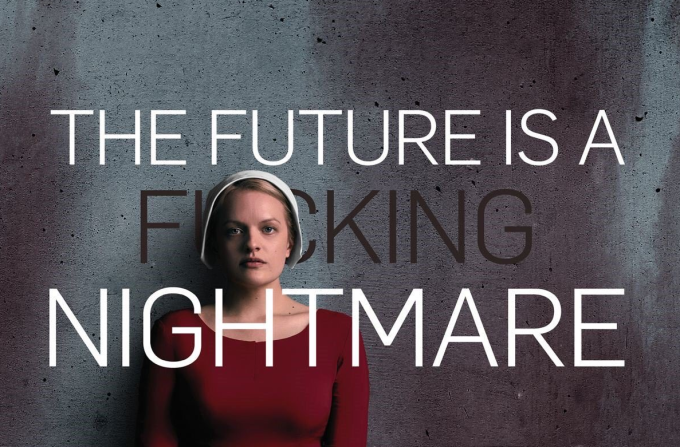
I watched "The Handmaid's Tale," so you wouldn't have to


HandmaidsParodyPoster


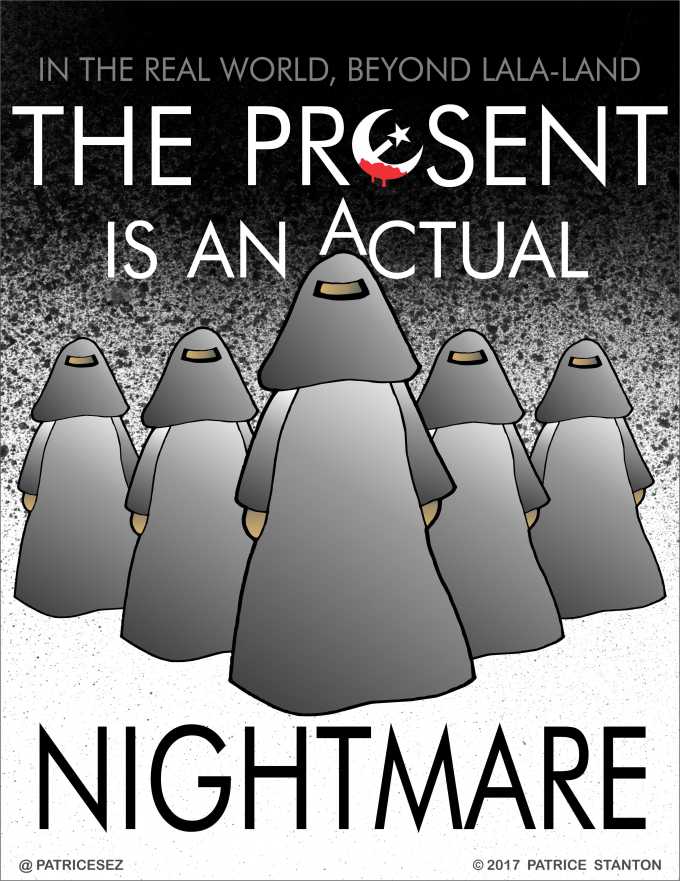
ActualHandmaidsPoster_Twitter.png


They missed the mark by "this much..."


If an editor had substituted an Islamic "call-to-prayer" for every tolling church-bell, a line from the Muslim-trifecta (Koran/Sunnah/Hadith) for every New Testament quote, and a head-to-fingertip-to-toe all black Islamic woman-shroud for the scarlet red Maids' robes, then I'd say Hulu has a winner with their 10-part cautionary, "The Handmaid's Tale." But as it stands? It's a Hate+Hit piece which slanders all Christians, but particularly Protestants (a cathedral is shown being demolished; a priest is among the regime's most hated, executed-by-hanging, next to an abortion doctor and a homosexual).

I took forteen (smallish-) pages of notes during the currently available three episodes, complete with hour-minute designations, just so I could go back and "perfect" the quotations. Honestly, though, I'm not sure I want to give that much thought to proving how stupid, misguided, and downright inciting-to-hatred-of-Christians this production and its "creatives" are. I think I'd rather put the effort into a more reality-based novella, addressing the problems of the very same sleep-walking Western feminists, who in "T.H.T.," wonder aloud, "How did we let it happen..."

I only shouted at the screen a few times, "Same way you're 'letting' Islamic supremacism happen, right now, you idiots!" They don't see it in the EU, so they sure as heck don't recognize it'll be on our horizon, next.

If only the creatives involved in the series (and the sure-to-be-legions of fans) had an ounce of shame, they could wake up before this nightmare scenario comes true via our Islamic "friends." They won't, because in 2017, as they did back after 1986's novel, and 1990's first screen production, they still actually expect Christians to go on a rampage nationwide, "stretching necks" and gouging out eyes and clitorises(sp?).

Because they refuse to look, they'll never see the caliphate coming.
Therefore, they will become the very characters they wrote or pretended to be.
("Nobody expects the Spanish Inquisition")


Saturday, January 9, 2016

Quickies: Entertainment, Not Politics

     Jennifer Lawrence has returned the talent, vitality, and girl-next-door charm to Hollywood that it once derived from Audrey Hepburn, Meg Ryan, and Sandra Bullock. Her movies Winter’s Bone, Silver Linings Playbook, and of course the X-Men and Hunger Games series have made her the most sought-after actress in the world today.

     That made it particularly sad to learn that she’s vilified both Christians and Republicans:

     Lawrence's comment on Christians came during an exchange about Kentucky County Clerk Kim Davis, the conservative Christian who was famously jailed for refusing to issue marriage licenses to same-sex couples on account of her deeply held religious beliefs. Lawrence, a native Kentuckian, described Davis as "the woman who makes me embarrassed I'm from Kentucky" and said that all the crosses carried by her Christian supporters "may as well be pitchforks."

     "Don’t even say her name in this house," Lawrence told the fashion magazine. "All those people holding their crucifixes, which may as well be pitchforks, thinking they’re fighting the good fight. I grew up in Kentucky. I know how they are."

     The star didn't have a much better opinion about the Republicans. Though she said she was actually raised a Republican, she said she can't get behind a political party that's anti-women.

     "I was raised a Republican, but I just can’t imagine supporting a party that doesn’t support women’s basic rights," said Lawrence.

     "It’s 2015 and gay people can get married and we think that we’ve come so far, so, yay! But have we? I don’t want to stay quiet about that stuff," she added.

     Well, she’s a young woman. Though talented, she doesn’t know much, and she comes from an environment where evangelical Christians might be a bit more forward about their convictions than is advisable for good neighbor relations. Along with that, it appears she’s bought into the Democrats’ “war on women” canard. Perhaps she’ll learn better as she continues to mature, though Hollywood tends to discourage stepping out of its left-liberal cocoon.

     But that’s not germane to her acting talent, or the quality of her movies. So it doubly saddened me to see the comment thread in this review of Joy immediately turn into a wrangle about Lawrence’s politics and her opinions about Christianity.

     Ace at AoSHQ once noted that it’s conservatives, not liberals, who are constantly talking politics. Though that’s a natural reaction to our treatment by the media and the political Establishment, it actually impedes our principal objective, which is to remove politics from as many areas of life as possible.

     When entertainers – people whose political opinions are no more valuable than yours or mine and quite probably less so – spout off as Jennifer Lawrence has, it would be better to ignore them. They’re entertainers. In all probability they know less than anyone else whose political or social opinions get any circulation. Would you take stock market tips from John Irving? Would you adopt George Lucas’s exercise routine? If you found yourself in need of child-rearing advice, would you go to Beyonce? If not, why worry about their politics?

     They’re entertainers, folks. They’re not geostrategists, military planners, or candidates for Pope. Just enjoy their movies, their music, and their novels. (But buy and read all of mine first. Twice. And get copies for your relatives, friends, and all your neighbors. Makes a fine Christmas gift!)

Friday, March 14, 2014

Son Of God

You'd be surprised, I'm sure, were some entertainment heavyweight to publicly condemn a movie that celebrates the life of Moses, or Muhammad, or Buddha as "spiritual bullying." You'd imagine that the heavyweight's colleagues would have the good sense to restrain him from such an emission if possible, and if not, to distance themselves from his comments afterward. After all, such figures are of major religious importance to millions of people, regardless of what any individual might think of them. Allowing religious persons to enjoy their preferences undisturbed is considered a fundamental rule of courtesy in America, the pretensions and presumptions of militant atheists notwithstanding.

It seems there are exceptions to that rule:

Peter Bart, the editorial director of Variety and a former film producer, fears Mark Burnett is hurting his brand with Son of God.

So he penned an "open letter" accusing Burnett of being a spiritual bully. Only he didn't have the courage to say so directly.

Bart is utterly unabashed about his disapproval of Burnett's movie:

The problem, Mark, is that when you encourage pastors, among others, to buy out multiplexes for “Son of God” in their communities, some would accuse you of a form of spiritual bullying.

Here are some big picture realities to ponder, Mark: Battles pitting faith-based voters against same sex marriage and the legalization of pot are heating up across Middle America. Many states are weighing legislation permitting businesses to refuse to serve presumably gay customers on “religious grounds.” So while you may take pride in “evangelizing” your film’s message, as you put it, you should also be aware that you are politicizing the Mark Burnett brand....

Indeed, your own biblical interpretations, Mark, have been challenged in some circles. “Taking Jesus into your life these days has become another form of instant gratification, one that avoids acknowledgement of denominational conflicts,” says producer John Heyman, whose Bible-informed television specials recently earned him a visionary award from the faith-based Movieguide organization....

You and your financial supporters, Mark, are banking that you will reach a wide audience that embraces your spiritual message. You might be right, but you might also be surprised by the pushback from those who feel that elements of the faith-based community, in advancing their cause, seem insensitive to the priorities of dissenters.

Don't be misled by the indirection, the "some would accuse," the "seem insensitive," and so forth. Peter Bart, a major figure in entertainment journalism, is expressing his own opinions and preferences. Were it otherwise, he would have penned analogous missives to the various entertainment figures who've produced works or made public pronouncements that attack Christianity, or religion generally.

The implication of Bart's pronunciamento is inescapable: Do not make a pro-Christianity movie. Dare to do so and the titans of the cinema world will treat you to a public denunciation beyond anything you can imagine.

There is, of course, one offense greater than merely to make a pro-Christian movie: making one that earns big bucks, as did Mel Gibson's personal and heavily pooh-poohed project The Passion of the Christ: a total of $612 million in global revenues.

But I digress. The entertainment world is top-heavy with persons actively hostile to Christianity. (Ironically, a goodly number of these describe themselves as "spiritual," which might be the biggest offense against language committed in this age of Man.) For them, Christianity is too "counter-cultural" -- that is, counter to their preferred cultural vision, in which "what's right is whatever's right for you." Such a movie cannot be allowed to stand on its merits; it must be derided from its inception and brutally slandered should it prove capable of drawing an audience.

The days when a movie such as The Greatest Story Ever Told could expect to receive approval, if not praise, from major figures in cinema is long gone. Such movies simply don't make enough room for the things Hollywood wants us to value: promiscuous, loveless sex; abortion on demand; the uncritical acceptance and endorsement of homosexuality; general moral nihilism; and the worship of the Omnipotent State and its current Messiah.

Before this, I'd planned to wait for the DVD of Son Of God. Now I intend to see it in the theater. What about you, Gentle Reader?