Showing posts with label language. Show all posts

Sunday, April 12, 2026

Automata And Idiomata

     On occasion I receive compliments for my facility with the English language. It’s a heartwarming thing, as the use and manipulation of symbols of all kinds has been my greatest asset lifelong. At such times I try to exhibit a modicum of modesty by reminding my admirer(s) that English is by far the world’s largest and most complex language. Its vocabulary is well over 2,000,000 words in size. I doubt I have the use of even five percent of that total. Then there’s English grammar and syntax, which we who speak it seldom reflect on, but which are as complex as any rule-based system ever devised.

     But all that, as overwhelming as it can seem, pales in importance before the extent to which communication in English depends upon the mastery of idioms.

     Idiom is a thing generally if vaguely understood. As idioms fly freely in our discourse, we must have both a sense for them and adequate skill at using them. Yet the sheer volume of idioms in even formal communications eludes most ordinary English speakers… until someone like your humble Curmudgeon comes along and points each of them out.

     No, this isn’t a dithyramb to the idiom or the services idioms render to us. It’s a reflection on peace and its requirements.

* * *

     Among the things that have kept peoples apart over the centuries, unintelligibility ranks high. Different countries have different languages. Within those languages they have different idioms. Until very recently, a traveler in a land where his native tongue isn’t spoken had to proceed with great caution. He could trip and fall over an idiom that a technical knowledge of the local tongue could not translate accurately.

     However, owing to the Anglo-American dominance of three key activities – finance, aviation, and computing – English, approximately of the American variety, has become the de facto international language. This is especially fortunate for Americans, who are well known to be unlikely to master a foreign language well enough to speak it fluently. It’s also fortunate for visitors to America from other lands, though they are often surprised at some of our abuses of our own tongue.

     But today, we have access to programs of remarkable power that can translate between any two of the world’s major languages. Google’s free Translate website, in particular, has been a great help to me, and no doubt to others as well. And of course pioneers in artificial intelligence have made great strides in programming their Large Language Models to do much the same.

     Yet beyond all that lies a problem domain that no one had dared to tackle until very recently: the real-time, multi-person, multi-language exchange. Imagine two hundred persons, each of whom speaks a language shared by none of the others, sitting together in a room and trying to converse. Imagine the complexity involved in arranging for mutual comprehensibility. Every utterance by any member of the group would need to be translated 199 times, immediately. Imagine the computing power it would consume.

     That is X, formerly known as Twitter. Persons from every currently spoken language make use of it. Time was, they’d have had no chance of communicating fluidly and comprehensibly with persons of other lands. No longer.

* * *

     AI translation services have matured greatly these past few years. However, AI programs are computing-power gluttons. Massive arrays of CPUs, memory, and storage devices are required for use by a single powerful AI. That’s one of the stiffest limitations on the application of AI programs at this time. Another, infrequently discussed, is the burden the idiomatic nature of human communication puts on such a program, for as I noted earlier, idioms defy straightforward translation.

     Enter Elon Musk. On his own initiative, Musk has dedicated a large fraction of the capabilities of his pet AI, Grok, to providing for the translation of tweets from any known language to any other – idioms and all. Thus, X users can talk to other X users without concern for language barriers. Considering the volume of traffic that flows through X, the processing power required by that application is mind-boggling. Yet Musk has made that translation service free to all X users.

     The enormity of this development defies description. People of widely separated lands are talking to one another, understanding one another, and discovering that they have little or nothing to fear from one another. They’re making friends with persons of nations whose governments are at war with their own. And they’re drawing the implications… no doubt much to their rulers’ dismay.

     It’s not peoples that fight wars. It’s governments – States. Those entities must induce their subjects to fight, for rulers don’t fight in the armies they dispatch. That requires propaganda to make “the enemy” appear evil, even inhuman.

     But fluid communication among the common peoples of nations defeats such propaganda. The State cannot “other the Other” if “the Other” is too plainly just like oneself. That vitiates the war effort at home. States resolved upon enmity toward others will have to deny their people access to X, lest they lose their grip.

     Elon Musk has been hailed for his enterprises SpaceX, Tesla, The Boring Company, and Neuralink, and deservedly so. But his greatest contribution to Mankind may lie in his use of his xAI firm to provide real-time translation services to X’s users. This is the route to peace… and possibly, if I may fantasize for a moment, to the end of that ravenous and wholly destructive institution we call the State.

     Thank you, Elon.

Saturday, October 11, 2025

The Mother Tongue

     [My regular Gentle Readers will already be aware that I have a burr under my saddle about good English. It’s become ever larger as the years pass, in part because of the sloppiness encouraged on the Web and by cell phones. We are approaching a point at which communication among Americans will become conditional on what schools the interlocutors attended, what books they’ve read, and whether their parents were wise enough to deny Junior a computer and a cell phone until the little bastard could purchase them for himself.
     But I have a long agenda for today, including the care and feeding of a wife who’s recuperating from major surgery, so rather than work up the spit for a wholly new and original rant, have a piece from the old Palace of Reason. It first appeared there on July 2, 2004. – FWP]

     There's been an interesting exchange of views recently on the subject of linguistic correctness, sparked by Connie Du Toit and continued by Aaron Haspel, among others. However, what makes it particularly interesting is not that any of these worthies has anything new to say on the matter. Rather, it's that no one who's been a party to the exchange has been willing to take one of the two most important poles of the debate.

     Well, your Curmudgeon does have his place in things.

     The "Ebonics" madness of a few years past ought to have been a warning sign, a shot across our civilization's bow. Persons with some following were advocating the creation of a separate linguistic community for blacks, on the grounds that the ghetto slang to which they'd attached the pretentious term "Ebonics" has "its own validity." Quite likely, none of these "educators" could define "validity" without several practice frames and a hint from the studio audience, but let it pass. The sensational aspect of the matter was the audacity of "educators" who argued for the "right" not to teach language disciplines to their charges. It completely occluded any discussion of why allowing black American youth to become an isolated linguistic community might be a bad idea.

     If you, gentle reader, are in any doubt about why it's a bad idea, consider the cage of limitation that encloses Hispanic immigrants who fail to learn English. Consider the contempt felt for them, by both native English-speakers and prior generations of immigrants who mastered the language. Consider the difficulties their children will have becoming English-speakers when their home environment presses Spanish upon them, rather than the tongue used by the society they hope to join, whose commercial and cultural opportunities they hope to enjoy.

     NASA astronauts have a saying: Communication Is Life. Indeed. Among other things, it's often the only way to persuade others not to kill you. What is generally not conceded by the excessively tolerant is that it's also the road to social acceptance, respect, and often to riches.

     Do you think your Curmudgeon overstates the case? His own fortunes are founded entirely on his communications skills. Yes, much of that was communication with computer systems, but the principle is the same. In fact, the starkness of that milieu helps to reveal the most important principles beneath the contention.

     But let's not jump to the climax of the argument quite so fast. It's worth developing a few important lines of thought, and the consequences of ignoring them -- all of which are historically well confirmed.

* * *

     If you've ever been exposed to Middle English, you already know what the temporal drift in the language has done to our ability to comprehend our forebears. Scholars put whole careers into decoding the argot of that time. Without their annotations, the texts left by famous medieval authors would be indecipherable by a layman.

     That drift occurred because of the difficulty of promulgating a language standard. The first printed books were still centuries away. Dictionaries were unknown. The class structure of pre-Industrial Revolution England guaranteed that the educated noble would speak an entirely different language from the commoner. Regional and occupational jargonization played a part as well.

     Though the sciences and technologies made slow progress during those centuries, there is still much to be learned from them, which makes it a tragedy that so few of us are capable of reading their documents. If we move forward to the Tudor era, the barriers thin somewhat, largely because of the rise of national and international trade, in which many English estates took some part. But only when industrialization made England into a massive importer of raw materials and a unique source of finished goods to be sold as widely as she could did the standardization of the English language become an urgent matter. The movable-type printing press made it possible. Among the first books to be widely produced and distributed were grammars and proto-dictionaries.

     It was about then that the persistent practices of inter-estate raids and violent sectional feuds ceased to trouble England as well. The muting of language differences seems to have played a part in the emergence of peace, though its importance is obviously open to dispute. There can be no dispute that general education received an enormous boost from the progress of linguistic regularization, and that the living standards of English commoners benefited greatly by it as well.

* * *

     The history of the ancient world features many mentions of the importance of the traveling trader as a source of news. What is seldom pondered is the prerequisite for that function: the ability to make oneself understood, which is of course also required by trade. In those days, he who traveled long distances to trade needed to be a polyglot, capable of speaking at least a minimum amount of several languages and handling the customs of several peoples as well. That, along with the requirements for integrity, competence, endurance, and self-reliance naturally limited the number of persons who could follow that star. Those few became very widely known, highly esteemed, and -- in a time of grinding, universal poverty -- very, very rich.

     Also significant from that time was the practice of using linguistic barriers to further campaigns of conquest and to secure enslavement. Armies were more willing to slay and enslave when their victims could not make themselves understood, which was a large part of the reason for the long journeys of barbarian armies such as the Vikings, Visigoths, Vandals, and Huns. Captured slaves and concubines were routinely put under the guardianship of men who could not understand them -- often, men who could only make themselves understood to their masters, and not by the larger surrounding population.

* * *

     Your Curmudgeon hopes it is understood by now that language differences are destructive barriers among men. Indeed, the effect is so powerful that, were he capable of waving a magic wand and eliminating all languages but one from human intercourse, now and forever, your Curmudgeon would not hesitate for an instant, even if it meant the permanent loss of all material written in any other tongue.

     But what would that mean? What is a language, that we might recognize this one as different from the one spoken over there?

     Quite simply, a language consists of three sets of rules:

  • A lexicon or vocabulary, which maps "atomic" symbols -- words -- onto extrinsic meanings through widely accepted definitions;
  • A set of rules of combination, more commonly called a syntax, by which symbols from the lexicon can be combined to form more complex descriptions, queries, and ideas;
  • An accretion of lexical compounds, usually called idioms, which map to meanings that are not obvious from the standard definitions of the "atomic" symbols in the compound.

     Divergence from any of these sets of rules impedes contemporary comprehensibility, unless and until the divergence becomes widely accepted. The comprehensibility of material from earlier times will be affected if the lexical elements they used cease to have meaning to a reader of our time, if the syntactical import of their constructions is lost, or if their idioms cannot be translated.

     Of course, if that earlier material has at most a marginal cultural value, "we" can "afford" to lose it. But "we" must not assume that "we" will always be on the receiving end of the wire, or that "they" will always have little of import to say. What of the future, when persons not yet born strain to make sense of our philosophical, scientific, cultural, political, and personal legacies?

* * *

     None of this argues for a language that never adds new words or idioms, and never lets idioms whose referents have ceased to matter lapse into unemployment. But it does press for the conservation of the basis of our language: its vocabulary, its syntactic rules, and the body of idioms whose meaning has been widely accepted. Only if those strictures are maintained will men be guaranteed to be comprehensible to other men.

     This stance is called prescriptivism. We who hold to it are often derided as grammarians consumed by the fear of unemployment.

     Prescriptivism comes in degrees, like so many other convictions. "Loose" prescription seeks to conserve only the thousand words that are indispensable to common speech, omitting nearly all descriptive words, all purely cultural markers, and all idioms without a commercial demand behind them. It sanctifies the dozen syntactic rules that allow the formation of simple statements and queries, usually leaving out complex conditionals, subjunctives, and advanced usages such as ablative absolutes, gerunds, and the pluperfect and future perfect tenses. Loose prescription gives rise to vertical divisions in a language: "low," "middle," and "high" dialects. Over time, these will become close to mutually incomprehensible. The speakers of these dialects will often be stratified by wealth and political privilege as well.

     "Middle" prescription adds to the conserved set of rules. To the base thousand words, it adds a range of "discretionary" adjectives and adverbs, common cultural words, and "less important" idioms. To the dozen innermost rules, it adds some conditionals missing from the "loose" protectorate, and perhaps some subjunctives and advanced usages, though far from a complete set. "Soon I shall have set this behind me" might not be conserved, but "Some day, this will be behind me" probably would be. Here, too, a vertical division will develop between formal and common speech. They will remain comprehensible to one another, but it will be common for persons to judge one another's social status according to their linguistic command, and harder for a person of low status to rise than might otherwise be the case.

     "Strict" prescription allows virtually no changes to existing vocabulary or syntactic rules. New vocabulary will be added to answer the emergence of new referents in the relevant semantic domain, but a word already defined is deemed sacrosanct. Syntactic rules about even the most complex usages are maintained as well. To be added to the expressive set, idioms must pass stringent requirements for cultural relevance and harmony with the language's other rules. Obviously, except for occupational specialty jargons, this approach to language will guarantee the maximum degree of common comprehension and the minimum trouble in decoding texts by writers distant in time.

     Even under strict prescription, there will be a colloquial dialect and a "high" or formal one. But speakers of the formal tongue will have no difficulty speaking to those conversant only with the colloquial one, which is not guaranteed under middle prescription and against the odds under loose prescription. Commerce will be served to the highest possible degree, and though there will still be language "snobs," there will be no impenetrable linguistic barriers against economic, cultural, or political advancement.

     Strict rules make linguistic attainment easier than loose ones.

* * *

     The earliest aim of American classroom education was the promulgation of a regular language. Indeed, there was a time when "grammar" schools taught little else, under a prescriptive regime so strict as to be incredible to Americans of today. The underlying assumption was that the ability to speak and write fluidly, comprehensibly, and with flair was the key to all of society's doors. The unprecedented economic and cultural mobility of Americans of the nineteenth and early twentieth centuries was strong confirmation of this thesis.

     Your Curmudgeon holds that the emergence of the permanent underclass -- persons born into poverty, who spend their whole lives mired in it, and bequeath the same to their progeny -- argues to the same effect.

     One cannot teach or learn an "undisciplined discipline" -- that is, a body of knowledge that has no enforced rules. This is as true of language as it is of mathematics. Language skills are so fundamental to the acquisition of any other sort of knowledge that the impossibility of creating well educated men who are not linguistically well equipped comes near to tautology. Put another way, by not insisting that our children acquire a rigorous command of English, and then stick to it, we virtually condemn them to mediocrity or worse in every other dimension.

* * *

     With all the racism-shouting going on today, your Curmudgeon is simultaneously amused and appalled that black and Hispanic "leaders" are so willing to accept operational illiteracy among young American blacks and Hispanics. Of course, the paradox is purely cosmetic: a "constituency" made helpless by lack of language skills is far more biddable than one which can integrate with the larger, more prosperous American culture. But for those of us not warped by a venal desire for power over others, the matter remains grave.

     Abraham Lincoln reminded us that "a house divided cannot stand." He was referring to the division between the free and the slave states, but the observation applies just as well to the division between literate and illiterate Americans, especially if the ranks of the illiterates continue to swell. As Charles Murray and Richard Herrnstein wrote in The Bell Curve, if that division were to be deepened and widened, it would force our society into the have / have-not pattern of Latin America, whose well-to-do live in hilltop garrisons guarded by men with guns to keep the impoverished masses below from approaching.

     The wide dissemination of high skill with the English language is the key to averting this fate. No other change to our educational practices or our cultural milieu comes near to that in importance. If it takes the ruthless red-penciling of billions of essays, endless drills in vocabulary and syntax, and the occasional public knuckle-basting of a recalcitrant student, so be it. Any other course is cruelty under the name of "tolerance," a sin against our young so black as to admit of no pardoning.

     Your Curmudgeon will now await the fusillades.

Monday, March 30, 2020

Ultra-Quickies: A Linguistic Grump

     To all those writing about the Wuhan virus:

Please Stop Using The Word Epicenter!

     Epicenter is a technical term from seismology. It refers to the point from which the temblors of a seismic disturbance appear to radiate. It is not a fancy synonym for center!

     Colloquially, epicenter is an approximate synonym for focus: the point on which attention concentrates in the course of an ongoing event. It would still be a distortion of the original meaning of the word, but not as bad a distortion as its use where center would be correct.

     You get no extra eloquence or erudition points for using a technical term incorrectly. Indeed, you lose them, with me and everyone else who believes words should be used according to their proper meanings.

Thursday, February 27, 2020

Forget The Coronavirus

     I’m thinking of a disease that should really worry you. You may already be aware of it, but it’s against the odds that you give it the priority it deserves.

     First, an illustrative conversation:

CSO: I tried to install Office on my laptop, and it failed!
FWP: Which version were you trying to install?
CSO: Not the Web-based one. It said my copy was installed on another computer!
FWP: But which version, specifically?
CSO: The one I’ve been working with! I’m so pissed. Do you have an uninstalled copy?
FWP: Sweetie, please gratify my curiosity: Which version?
CSO: (puzzled) What do you mean, which version?
FWP: Office 2007, 2010, 2013, or 2016?
CSO: Oh! 2013, like I have at work.
FWP: (collapses from exhaustion)

     I’m not a hardass. Really, I’m not. But the above exchange, which fits into a schematic with which I’m entirely too familiar, has become so commonplace that these days I follow a policy of responding to such emissions with a grunt. Engaging the complainant more deeply would likely leave me paralyzed with despair, in mourning for the English language, catapult me into a towering rage, or all three.

     Take a moment over this incident, Gentle Reader. Diagnose the underlying malady. Not the symptoms; the true disease from which the symptoms all spring. Then and only then should you proceed to the remainder of this tirade...assuming you don’t feel an urgent need to lie down in a dark room with a cool cloth over your forehead.


     There are a lot of symptoms on display in the above. One of them is mine: a need for specific information and a refusal to go on without it. Engineers can be like that. Don’t just tell us that the program crashed. We need to know the prior condition of the program, what input immediately preceded the crash, the specific error message (if any) the program emitted, your maternal grandmother’s blood type, and what you had for breakfast. Without a full and proper description of the context, we can do nothing for you.

     The modern tendency is to dismiss those needs and scream for immediate assistance. Note the word scream. I used it deliberately. What information does a scream convey, other than “I’m really upset” -- ?

     The answer to that question will get us close to the malady. Is anyone ready with it? Anyone? You in the back row with the mozzarella goatee: Is your hand up because you have the answer or are you just relieving a cramp?

     That’s right: Nothing. Apart from the fury of the screamer, a scream offers the hearer no information whatsoever. It gives the hearer nothing to go on.

     Now, I’m aware that the occasional scream can relieve all manner of unpleasant tensions and stresses. When mated to hoarse breathing, rigid muscles, and “OhGodohGodohGod” it can even be gratifying to hear. But that’s the limit of its utility.

     It’s not just the new Number Two who wants information.


     This delightful disembowelment of an especially fatuous New York Times article is valuable for many reasons. I urge you to wallow in its charms. However, it slightly under-weights the root problem beneath the symptom it addresses: why it is that so few young Americans are able to write comprehensibly.

     The author, writer Lori Janeski, hits a lot of high, sweet notes, including the willful refusal of the very teachers supposedly dedicated to attacking the problem of poor writing to address the need to judge: i.e., to openly declare a poor attempt at written expression poor, and to rub the student’s nose in his failure. That is indeed a critical need, but we must ask the next question. What countervailing force prevents these ostensibly well-intentioned teachers from saying “This is unsatisfactory” or any equivalent? Why can’t (or won’t) they do so? What is the underlying disease?

     Would you be ready, willing, and able to do so, Gentle Reader? If not, why not?

     “Negative feedback,” we are told, is bad. It can wound the student’s “self-esteem.” That could get him to thinking he’ll never win the big game, get the girl, or become president. He might succumb to existential despair, turn to sex with sheep, and end his life in a back alley, drinking Woolite.

     But negative feedback is the indication that you have to shape up. Without it, you’re far too likely to go on as you’ve begun, making the same mistakes over and over. Sometimes pain and effort will be involved. Negative feedback, in the form of a lot of extra-base hits, a four-digit ERA, and repeatedly being sent to the minors, is why pitchers learn to throw a curve ball, despite the pain – and you can take it from me, there’s plenty of pain, both during and afterward. Most of the feedback Nature gives us is negative. If Nature hadn’t told Australopithecus erectus that he was being an asshole for not using the antelope femur as God intended, he wouldn’t be on the Moon today.

     The “Self-esteem uber alles” movement is the antithesis of negative feedback. It’s the overarching reason why Johnny can’t read, write, spell, do simple arithmetic, hold a job, or master the terrifyingly advanced concepts involved in loading and operating the dishwasher. “Feelz” have been given pride of place and “knowz” relegated to the outer darkness.


     I could go on in a thousand different directions, but life ends too soon. Suffice it to say that we cannot reasonably expect better from our young folk unless we are willing to wound their feelings – that is, to say “This sucks; you can do better, and before I’m through with you you will,” and mean it.

     When you find yourself becoming too concerned with Johnny’s feelings, apply the remedy parents of earlier generations used to such good effect: the prospects for Johnny’s future. I mean, do you want him living in your basement until he’s old enough for a nursing home? Think, man, think!

Wednesday, January 1, 2020

The Power Of Crisis

     If everything’s a crisis, where’s the crisis? -- Arthur Herzog

     Think about that word: crisis. Think about the times in your own life when you became persuaded that you were facing a crisis. What sort of emotions and motivational predispositions went along with that sense? “The wheels are coming off, lives are at stake, there’s no time to lose, we’ve got to act now!” Right? Pretty serious stuff, eh what?

     Activists’ promotion of a crisis is aimed at inducing exactly those reactions in their targets. Of course, there are requirements for the successful promotion of a crisis. In recent years very few candidate-crises have been promoted by persons or agencies that could meet those requirements objectively. Nevertheless, crisis-shouting has so much power that there will always be some persons – some innately gullible; others avid for a feeling of importance or significance; still others merely desirous of a little excitement – who will respond affirmatively to the cries.

     Crisis-shouting is a major weapon in the arsenal of the power-seeker. Why else would we have been bombarded with propaganda about world-hunger “crises,” environmental “crises,” homelessness “crises,” energy “crises,” inequality “crises,” global-warming “crises?” Those and many other supposed problems were all to be addressed with big-government solutions. The consistency among the activists’ demands is impossible to overlook.

     As it happens, there’s a new book on the subject:

     Why does government keep growing? Drawing on Mancur Olson’s Rise and Decline of Nations and Robert Higgs’ Crisis and Leviathan, we show how the negativity effect is exploited by journalists, politicians, academics, lobbyists and activists — the merchants of bad, as we call these doomsayers — to scare people into adopting policies that benefit politicians, bureaucrats and special interests while hurting everyone else. Whether you’re absorbing today’s bad news or contemplating the future of humanity, we suggest starting with three assumptions:
  • The world will always seem to be in crisis.
  • The crisis is never as bad it sounds.
  • The solution could easily make things worse.

     And it will be my first physical-volume purchase of this Year of Our Lord 2020.


     The true crisis – i.e., a state of affairs wherein a great many lives really are at stake, and immediate action is imperative if they’re to be saved – is self-announcing. Its characteristics tend to indicate the nature of an effective, life-preserving response. Therefore, neither the crisis nor the proper solution has any need for promotion or promoters. But that’s insufficient to meet the needs of those who yearn for power, or to feel important.

     In this regard a look back at world conditions two years ago is instructive:

     Consider the U.S. just three decades ago. Our annual homicide rate was 8.5 per 100,000. Eleven percent of us fell below the poverty line (as measured by consumption). And we spewed 20 million tons of sulfur dioxide and 34.5 million tons of particulate matter into the atmosphere.

     Fast forward to the most recent numbers available today. The homicide rate is 5.3 (a blip up from 4.4 in 2014). Three percent of us fall below the consumption poverty line. And we emit four million tons of sulfur dioxide and 20.6 million tons of particulates, despite generating more wealth and driving more miles.

     Globally, the 30-year scorecard also favors the present. In 1988, 23 wars raged, killing people at a rate of 3.4 per 100,000; today it’s 12 wars killing 1.2 per 100,000. The number of nuclear weapons has fallen from 60,780 to 10,325. In 1988, the world had just 45 democracies, embracing two billion people; today it has 103, embracing 4.1 billion. That year saw 46 oil spills; 2016, just five. And 37% of the population lived in extreme poverty, barely able to feed themselves, compared with 9.6% today. True, 2016 was a bad year for terrorism in Western Europe, with 238 deaths. But 1988 was even worse, with 440.

     The headway made around the turn of the millennium is not a fluke. It’s a continuation of a process set in motion by the Enlightenment in the late 18th century that has brought improvements in every measure of human flourishing.

     Things are so good, and getting better so relentlessly, that the crisis-shouters are tearing their hair out. They’re in urgent need of a crisis, and there aren’t any handy! How on Earth are they to grab for more power over us, or elevate their tawdry little existences to some degree of existential significance? Something has to go wrong, and at once!

     It makes me so sad that I’ve been walking around laughing uncontrollably.


     All right: yes, there is one crisis to be addressed with dispatch. It affects virtually every English speaking human being. Its prevalence is such that virtually every day I’m tempted to hurl a book across my living room with a scream that “Adverbs never killed anyone!”

     It’s the “on a XXX basis” crisis.

     You’ve surely read or heard this particular verbal fad in recent days. “On a regular basis.” “On a daily basis.” “On a constant basis.” Great God in heaven, people! Use the BLEEP!ing adverb without encrusting it that way: “Regularly.” “Constantly.” “Daily.” It won’t hurt you; indeed, the improvement in the concision of your spoken or written English will be to your benefit. “Forcible writing is concise.” (Will Strunk of The Elements of Style) “If it is possible to cut a word out, always cut it out.” (George Orwell) Save your syllables and your breath for when you really need them – and as I’ve been feeling an ever stronger desire to strangle someone for saying “on a daily basis” or something analogous, that need might not be far off.

     Once that crisis has been successfully dealt with, I’m certain that Utopia will be on the horizon.

     Happy New Year!

Friday, December 29, 2017

Words Have Meanings Part 1

     As I sit here, contemplating the exact direction in which I’d like to steer this essay, I find myself reflecting on...myself.

     Time was, I was a working physicist. Not for long; I threw it over in favor of software engineering while I was still quite young. I did so because I found the work uninteresting owing to its narrow focus, and the academic environment uncongenial owing to the extremes to which people in academia tend to fight over trivia. However, the experience was valuable, perhaps more for one reason than all others combined: It revealed to me how readily people, including people who claim to be concerned with accuracy and precision, will resort to ambiguities and imprecisions that amount to deliberate deceit if it will get them what they want.

     That realization would elicit the central driving influence of my life. I became all but obsessive about saying exactly what I meant. In any discussion of anything whatsoever, I strove to use the correct word, allowing for topical and contextual considerations, that would most accurately, precisely, and clearly capture my intended meaning. I was equally at pains to grasp exactly what my interlocutor meant by every word he employed.

     Suffice it to say that it didn’t make me a big hit at parties.

     Nevertheless, I maintained that practice. I’ve maintained it to this very day. Senility and its ravages to the side as exceptions, I doubt I’ll ever willingly abandon it.

     As you could surely have guessed, the emotional infrastructure that supports that attitude has more than one effect.


     I purely despise people who deliberately twist or mangle the meanings of words. I particularly despise polemicists who do so to “make a point,” to win (or escape) an argument, or to con a listener into believing or doing something he wouldn’t otherwise believe or do. They are beneath contempt. Indeed, they’re responsible for a huge fraction of our contemporary sociopolitical fractiousness.

     Words are our fundamental tools of both communication and thought. They deserve all the respect and defense we could possibly give them. When I discover that I’ve encountered a word-rapist, I hurry to put as much distance between us as possible...as much for his sake as for mine. It makes political exchanges difficult, sometimes hazardous.

     One of the symptoms of our steadily hardening political division is the increasing frequency with which words are abused in such exchanges.

     While it’s accurate to say that some word-rape occurs on the Right – no sector of politics is free from it – the major (and most gleeful) practitioners of word abuse are on the Left. Indeed, I would argue that the Left could not have made the political gains it’s accrued over the century past without its extensive abuse of the English language. George Orwell had his take on the subject; this essay is mine.


     “I’m going to say something really crazy: I believe in science. Climate change is real and we have a moral obligation to protect this Earth for our children and grandchildren.” – Elizabeth Warren, U.S. Senator from Massachusetts, in a recent “tweet.”

     There are two kinds of people from whom an utterance of the above sort could come:

  • Idiots;
  • Villains.

     Miss Warren, a thoroughly odious figure whose political ascent has had me worried ever since she defeated Scott Brown, is not an idiot. The implication is left as an exercise for the reader.

     But let’s not hurry away. Let’s look closely at the statement, the specific words used, and the particular abuses Miss Warren has committed in it.

     “I’m going to say something really crazy.” What is the meaning of crazy? Doesn’t it mean psychotic, deranged, or in a mental state of unreality? If Miss Warren’s statement was accurate – i.e., if it accurately described her mental state – would there be any point in listening to her on any subject? If her statement was inaccurate, what was her purpose in making it? Satire?

     “I believe in science.” Seldom has so much semantic noise been crammed into a four word sentence. To believe is to accept some proposition without demanding a rigorous proof thereof. It’s only appropriate in discussing statements about specific facts, or propositions about cause and effect. But in what does Miss Warren believe? “Science.” But what is science? It’s a compressed way of referring to scientific method: a process by which one can investigate the causal mechanisms of the natural world. One cannot “believe” in “science;” one can only practice it or dismiss it.

     “Climate change is real.” Meaning what? That the climate – i.e., the general meteorological tendencies of the atmosphere that recent years have led us to expect – is changing? No one disputes that. Earth’s climate has been changing since it acquired its atmosphere. This is a palmed-card technique: a way of invoking catastrophic anthropogenic climate change, a tendentious, heavily politicized hypothesis about Mankind’s influence on Earth’s climate that’s unsupported by objective evidence.

     “We have a moral obligation to protect this Earth for our children and grandchildren.” Again, meaning what? Where does morality come into it? Morality is a useful concept only in discussing individuals’ treatment of other individuals. There’s no moral component to one’s decision to make, use, buy, or sell something unless violence, theft, or fraud are involved. Moreover, the “children and grandchildren” might not exist. At any rate, fewer are being produced than at any previous point in history.

     Word rape from beginning to end, all of it in service to a political position for which there is no evidentiary support and precious little interest from the American public.


     As one who writes fiction as well as these interminable op-eds, I need to maintain and manage two contrasting attitudes toward words and verbal expression. Fiction writers must occasionally resort to various “devices:” similes, metaphors, metonymies, images, coinages, synecdoches, hyperboles, and litotes. But the fictioneer’s mission varies from that of the expositor: to evoke mental pictures in the reader’s mind, to cause him to feel particular emotions, and to bind him to the story being told. The expositor is expected to “keep to the firmest footing:” i.e., to express himself with the greatest degree of accuracy, precision, and clarity the language will support. Keeping those missions separate involves keeping the linguistic practices appropriate to them separate.

     The expositor must not abuse the words he employs. He must not engage in rococo phrasings or verbal tarantellas that dazzle the listener so he can change the subject without being caught at it. He must be an honest vendor of both information and implication. To do otherwise is to corrupt.

     A great many persons engaged in political polemics have consciously embraced corruption.

     More anon.

Tuesday, May 23, 2017

“Your Healthcare”

     As one who is serious about the meanings of words and sensitive to their misuse, I got a particular jolt of adrenaline out of the title of this piece...and not just from the neologism “healthcare.”

     Do you own any “healthcare?” Myself, I’m not sure. What does it look like? Is it something I’d keep in the kitchen, or a desk drawer, or perhaps in a bedroom closet? All I’ve found anywhere I’ve looked to date has been recognizable stuff that belongs where I keep it.

     Maybe the C.S.O. has it. If it’s large, it might explain why she’s been encroaching on my closet space again.

     I’m sure my Gentle Readers get the point. “Healthcare” – properly, medical care — is a service provided by others, usually for a fee. It’s not something to which one can lay a property claim. Medical goods such as pills, vaccines, bandages, crutches, and wheelchairs can be property, but of themselves they don’t constitute medical care. They’re merely aids to recovery from disease or injury, which can be used or misused...and if misused, they can set back your actual health as effectively as a shotgun blast.

     None of the above has any effect on such as Congressional Minority “Leader” Nancy Pelosi:

     Pelosi accused the Republicans of trying to jam a repeal-and-replace bill through Congress not for health-related reasons, but to set the stage for a tax reform proposal providing hundreds of billions of dollars in cuts for the rich.

     “They’re in a hurry … because they need this money to give a tax break to the wealthiest people in our country. This bill will have the biggest transfer of wealth in the history of our country — Robin Hood in reverse,” she said.

     “That is the goal of their tax bill, but they need this money from your healthcare in order to do that.” [Emphasis added by FWP.]

     I’m equally sure my Gentle Readers will get what this...person is attempting to do through her phrasing.


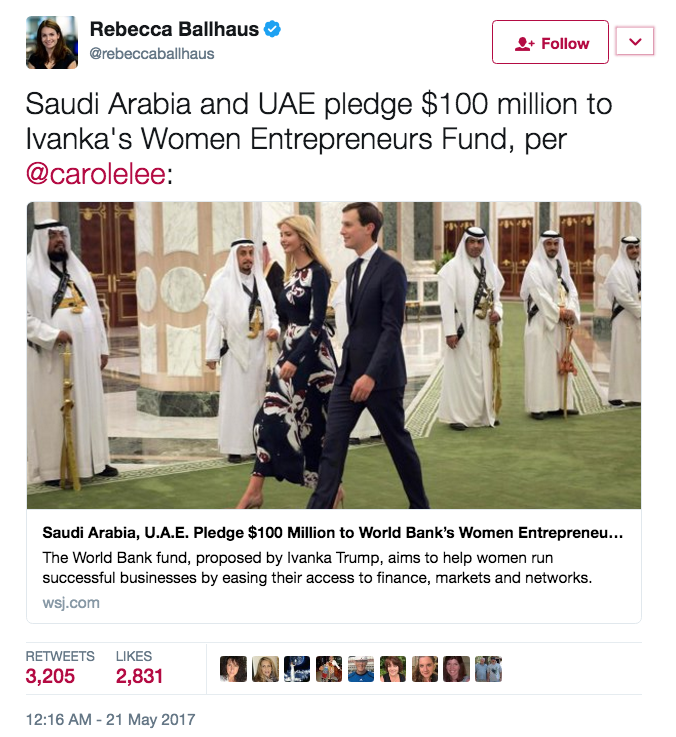
     It sometimes seems that the entire Leftist project relies upon verbal obfuscation. Leftist mouthpieces certainly do a lot of it. This business about “your healthcare” is currently the most important battlefield, but it’s not the only one. Note how they transform the World Bank’s Women Entrepreneurs Fund into a personal project of Ivanka Trump’s:

     This weekend, the Wall Street Journal‘s Carole Lee wrote a perfectly accurate story about Saudi Arabia and the United Arab Emirates pledging to donate $100 million to a World Bank fund for women entrepreneurs. The article noted that the fund was Ivanka Trump’s idea and that she was at the event where the pledge was announced.

     When Wall Street Journal reporter Rebecca Ballhaus tweeted out a link to her colleague’s story, she spun it in such a way as to add inaccuracies. First she reclassified a World Bank fund as a fund belonging to Ivanka Trump.

     Then she claimed that the donation from the two countries were therefore akin to what Trump pilloried Hillary Clinton for.

     Please read the whole thing...and feel your blood pressure rise. Through verbal sleight of hand, a World Bank initiative of which merely approves Ivanka Trump has become her personal fund – even though she has no control over the money, neither where it comes from nor how it will be used. And the Left leaps upon it with a tiger’s ferocity, eager for a new flail with which to flog a popular member of the First Family! This is just one of the more recent examples of Leftist deceit through verbal misdirection.

     Was this donation an attempt by the Saudi royal family to curry favor with President Trump? Probably. Neither the Saudis nor Muslims generally look favorably upon independence among women. But neither Trump, nor his daughter Ivanka, nor anyone else in the First Family will benefit materially. It’s merely a donation to an undertaking Ivanka Trump has mentioned favorably.

     Yet virtually the whole of the Punditocracy, including quite a few Establishment-aligned pseudo-conservatives, constantly deride President Trump for his locutions. It is to laugh.


     I can’t resist reposting the following slice of the Analects of Confucius:

     Zi-lu said, "The ruler of Wei has been waiting for you, in order with you to administer the government. What will you consider the first thing to be done?"

     The Master replied, "What is necessary to rectify names."

     "So! indeed!" said Zi-lu. "You are wide of the mark! Why must there be such rectification?"

     The Master said, "How uncultivated you are, Yu! A superior man, in regard to what he does not know, shows a cautious reserve.

     If names be not correct, language is not in accordance with the truth of things.

     If language be not in accordance with the truth of things, affairs cannot be carried on to success.

     When affairs cannot be carried on to success, proprieties and music do not flourish.

     When proprieties and music do not flourish, punishments will not be properly awarded.

     When punishments are not properly awarded, the people do not know how to move hand or foot.

     Therefore a superior man considers it necessary that the names he uses may be spoken appropriately, and also that what he speaks may be carried out appropriately.

     What the superior man requires is just that in his words there may be nothing incorrect."

     Confucius’s remonstrance to Zi-lu is of contemporary relevance and staggering importance. Alternately, we have this critically important essay by George Orwell:

     In our time, political speech and writing are largely the defence of the indefensible....Thus political language has to consist largely of euphemism, question-begging and sheer cloudy vagueness. Defenceless villages are bombarded from the air, the inhabitants driven out into the countryside, the cattle machine-gunned, the huts set on fire with incendiary bullets: this is called pacification. Millions of peasants are robbed of their farms and sent trudging along the roads with no more than they can carry: this is called transfer of population or rectification of frontiers. People are imprisoned for years without trial, or shot in the back of the neck or sent to die of scurvy in Arctic lumber camps: this is called elimination of unreliable elements. Such phraseology is needed if one wants to name things without calling up mental pictures of them. Consider for instance some comfortable English professor defending Russian totalitarianism. He cannot say outright, ‘I believe in killing off your opponents when you can get good results by doing so’. Probably, therefore, he will say something like this:
     ‘While freely conceding that the Soviet regime exhibits certain features which the humanitarian may be inclined to deplore, we must, I think, agree that a certain curtailment of the right to political opposition is an unavoidable concomitant of transitional periods, and that the rigors which the Russian people have been called upon to undergo have been amply justified in the sphere of concrete achievement.’

     As horrifying as is such verbal legerdemain when it’s used to conceal or defend atrocities, it’s even more threatening when it goes on the attack, as our political elite has lately done. And it’s high time that the American people should rebuff it brutally...if they’re still capable of recognizing it when they read or hear it.

Saturday, February 11, 2017

The Subversive Process In Our Time

     This piece has a prerequisite: before continuing on, read Dystopic’s recent and highly relevant essay. Note especially this paragraph:

     When I say “nationalist” what is the first thing that comes to mind? For most Americans, nationalism is tainted by Nazism. Any mention of nationalism brings up images of fascists, and genocidal maniacs, and racial supremacists. Why? Nationalists, i.e. people who love their country and its people, have been around since the dawn of civilization. Nationalism is neither inherently good, nor evil. It merely is. Certainly it can be used for evil purposes, as the Nazis did. But it can also be used for good purposes, as used by the patriots of the American Revolution. Yet the word is irrevocably tainted. That is ideological subversion at work. Pride in your country brings feelings of guilt, for things you have never done, nor would ever countenance yourself.

     The amount of useful information implied by that paragraph is phenomenal. It points to a destructive machine, built carefully and operated ruthlessly by persons hostile to the United States, its people, and our culture. The machine was first set in motion in the early Twentieth Century. It’s still in operation, still grinding away at our self-concept as Americans. Until it’s halted and dismantled, there will be no peace among us.


     The paragraph I cited above provides fuel for an appreciation of both the power of the machine and its particular vulnerability. Consider the following two exchanges:

     She: Nationalism is evil.
     He: Well, okay, but I’m really a patriot.
     She: (Attacks the U.S. for imagined crimes, tainting the claim to patriotism.)

     Or:

     She: Nationalism is evil.
     He: Define the concept and prove your case.
     She: (Rendered speechless.)

     The Left’s most important gains have come from intimidating decent persons out of the sort of riposte in the second exchange. There are several components to this:

  1. An arbitrary claim to the moral high ground;
  2. The severance of history from the modern mind;
  3. The deliberate distortion of important words and phrases;
  4. A relentless effort to induce unearned guilt: some for crimes committed by others, some for wholly imaginary incidents.
  5. An implied offer of absolution in exchange for political abasement.

     Just about every “ism” the Left seeks to use against us in this fashion is founded on that approach, or a gentle variation, and can be defeated in a similar fashion. Consider:

     She: You’re a racist!
     He: I am not. I have lots of black friends.
     She: (Impugns his attitudes and convictions.)

     Or:

     She: You’re a racist!
     He: Yes, I am. Everyone is. So what?
     She: (Rendered speechless.)

     The riposte consists of denying the intimidating power of the epithet. Note what this does to the various components of the machine:

  1. It dismisses the claim of moral superiority;
  2. It implicitly treats racism as normal and unexceptional;
  3. It shrugs aside the use of “racist” as a bludgeon-word;
  4. It refuses the imputation of guilt;
  5. And of course, if there is no guilt, there’s no need for absolution.

     Ponder that for a moment while I fetch more coffee.


     To subvert is to turn a targeted person against his previous allegiance. When that allegiance is to a palpable entity – e.g., an army or a ruler – the entity must be made to appear unworthy of the allegiance in the target’s eyes. When the allegiance is to a set of ideals – e.g., freedom of expression or association – the ideal itself must be invalidated.

     Certain ideals appear obviously good and desirable to most Americans. Freedom of expression is one such. To subvert allegiance to it, the Left has strained to make it appear noxious, usually by the use of the concept of “hate speech.” Inasmuch as this is only a phrase in the Left’s lexicon, Leftists can use it to mean whatever might be useful to them at some time or place. The phrase itself is intended to convey a sense of guilt or shame. If the target treats it as having a real, objective meaning, his self-regard could be hulled by the attack, rendering him vulnerable to ongoing subversion. Immediately ripping the weapon out of the Leftist’s hands – i.e., dismissing the phrase as meaningless – provides the best counter.

     Many an exchange would cease right there. Once the demon-phrases and concepts are torn from his hands, the typical Leftist has nothing else in his arsenal. Of course some will resort to violence, but that’s a subject for another screed.


     Rather than make heavy weather out of this, I’ll conclude by citing George Orwell:

     “Don’t you see that the whole aim of Newspeak is to narrow the range of thought? In the end we shall make thoughtcrime literally impossible, because there will be no words in which to express it. Every concept that can ever be needed, will be expressed by exactly one word, with its meaning rigidly defined and all its subsidiary meanings rubbed out and forgotten. Already, in the Eleventh Edition, we’re not far from that point. But the process will still be continuing long after you and I are dead. Every year fewer and fewer words, and the range of consciousness always a little smaller. Even now, of course, there’s no reason or excuse for committing thoughtcrime. It’s merely a question of self-discipline, reality-control. But in the end there won’t be any need even for that. The Revolution will be complete when the language is perfect.”

     Also, from this vitally important essay:

     Stuart Chase and others have come near to claiming that all abstract words are meaningless, and have used this as a pretext for advocating a kind of political quietism. Since you don't know what Fascism is, how can you struggle against Fascism? One need not swallow such absurdities as this, but one ought to recognise that the present political chaos is connected with the decay of language, and that one can probably bring about some improvement by starting at the verbal end....Political language — and with variations this is true of all political parties, from Conservatives to Anarchists — is designed to make lies sound truthful and murder respectable, and to give an appearance of solidity to pure wind.

     Verbum sat sapienti – and I mean that literally.

Wednesday, May 27, 2015

Quickies: The “Overclass”

     I hadn’t encountered this charming term before this morning. It has a lot more impact than “elite” or “political class,” and should be moved into our customary lexicon with dispatch.

     It appears in an article significant for other reasons, though it’s more than two years old: Rod Dreher’s short piece on “the law of merited impossibility:”

     The Law Of Merited Impossibility is an epistemological construct governing the paradoxical way overclass opinion makers frame the discourse about the clash between religious liberty and gay civil rights. It is best summed up by the phrase, “It’s a complete absurdity to believe that Christians will suffer a single thing from the expansion of gay rights, and boy, do they deserve what they’re going to get.”

     Punchy, eh? “No, that can’t happen, but when it does, you’ll deserve it!” Given the speed with which traditional rights’ protections of individual latitude in speech and association are eroding, the “Law” might soon become merely a footnote of historical interest...but note how often it’s employed in the emissions of Leftist dribblers!

     It calls to mind the fiery exchanges over the Equal Rights Amendment that graced the late Seventies. That atrocity, which would have awarded Congress essentially unbounded power to legislate on matters of sex, failed by a narrow margin and the heroic efforts of Phyllis Schlafly:

     Schlafly focused opposition to the ERA on traditional gender roles, such as only men should do the fighting in wartime. She pointed out that the amendment would eliminate the men-only draft requirement and guarantee the possibility that women would be subject to conscription and be required to have military combat roles in future wars. Defense of traditional gender roles proved to be a useful tactic. In Illinois her activists used traditional symbols of the American housewife. They took homemade bread, jams, and apple pies to the state legislators, with the slogans, "Preserve us from a congressional jam; Vote against the ERA sham" and "I am for Mom and apple pie."

     According to historian Lisa Levenstein, the feminist movement in the late 1970s briefly attempted a program to help older divorced and widowed women. Many widows were ineligible for Social Security benefits, few divorcees actually received any alimony, and after a career as a housewife, few had skills to enter the labor force. The program, however, encountered sharp criticism from young activists who gave priority to poor minority women rather than the middle class. By 1980, NOW downplayed the program as it focused almost exclusively on the ERA. Schlafly moved into the vacuum. She denounced the feminists for abandoning older middle-class widows and divorcees in need, and warned that ERA would equalize the laws for the benefit of man, stripping protections that older women urgently needed. She said the ERA was designed for the benefit of young career women and warned that if men and women had to be treated identically it would threaten the security of middle-aged housewives with no current job skills. The ERA would repeal protections such as alimony and eliminate the tendency for mothers to obtain custody over their children in divorce cases. Her argument that protective laws would be lost resonated with working-class women.

     Back then, the gender-war feminists, who had established significant bastions within the overclass, particularly the main stream media, were practically licking their chops over what they were going to do to the “patriarchy” – nearly all of which would be impossible without the ERA. Yet Schlafly, a woman roundly hated by the overclass and excluded as far as possible from media attention, mobilized sufficient opposition to stop them, merely by compelling us to face the probable consequences posed above.

     It seems the overclass can be defeated if we but make the effort, no?

Sunday, May 3, 2015

Quickies: The Further Destruction Of Language

     Were you aware that ”yes” can actually mean “no?”

Why Yes Can Mean No

     It started with “consent is sexy.” But, of course, there was no point in that—it was like saying rape is just bad sex, instead of a felony. Then there was “consent is mandatory.” It was much better, reminding us that sex is consensual, and everything else is rape. But then there was me, after a party, in a man’s dorm room. And there was “is this ok?” If we are being legal about this, I said ‘yes’ — no coercion, no imminent threat of violence, no inebriation (well, not a lot, anyway). But what I want to talk about is what happened before I said yes, who taught me to say yes, why I thought it was better to say yes, and why I really meant ‘no.’

     ....For me, and many others like me, consent isn’t easy. Yes doesn’t always mean yes, and we misplaced ‘no’ several years ago. This experience isn’t random, but disproportionately affects oppressed communities. Consent is a privilege, and it was built for wealthy, heterosexual, cis, white, western, able-bodied masculinity. When society has taught some of us to take up as little space as possible, to take all attention as flattery, and to be truly grateful that anyone at all could want our bodies or love, it isn’t always our choice to say yes.

     Consent as a privilege doesn’t just happen in sex. It happens for those of us who give too much in friendships without knowing how to ask for reciprocation, who let doctors touch us in ways that are triggering because we don’t want to make trouble, who dance with handsy strangers because our friends already left the party, who stick around in toxic relationships because we don’t know if we’re allowed to expect better. When you’re poor, disabled, queer, non-white, trans, or feminine, ‘no’ isn’t for you. I don’t mean to insist that every person oppressed in these systems of power can’t have empowering consensual experiences, and I know many who do. What I do mean to say is that for me, finding ‘no’ is a process, consent is elusive, and sometimes, even when people don’t mean to—they hurt me.

     (Link courtesy of The Other McCain.) Gee, if I interpret this in the fashion of a person taught by “society” to believe women are the equals of men in all things, it means they’re inveterate liars who should never, ever be taken at their word.

     BONUS! Jordan Bosiljevac, the author of the quoted diatribe, wants the privilege of “yes meaning no” to apply to all “oppressed” communities! So we white Christian heterosexual men must withdraw all trust from any member of any group, however defined, that claims to be “oppressed!”

     You know, I find an article like this refreshing. The writer has no idea just how much she’s given away. She has no idea what it implies – and would surely disavow all knowledge of its implications. Those are for us white capitalist patriarchs who reason according to the oppressive norms of logic.

     If this seems harsh, just imagine how harsh we would find a regime in which a white man could not trust the word of:

  • A woman;
  • A Negro or Amerind;
  • A person of a different religion;
  • A person of a different ethnic background;
  • A person of a different sexual orientation.

     All the above claim to be “oppressed.” Therefore, any consent they may seem to offer is really “coerced” by “society.” Slavery isn’t dead; it’s just been resting!

     You can thank your local neighborhood victimist activists – of whatever stripe – for this. It’s the end they’ve aimed for from the beginning, whether they knew it or not. And it never had but one terminus.

Tuesday, November 18, 2014

What Makes A Word Offensive?

Just yesterday, I had an email exchange with another fellow over whether the word Negro is offensive. Because it’s the technical anthropological term for one of the three major races of Man, I maintained (and maintain) that it isn’t. Here’s his reply:
Don't play dumb with me, Francis. "Negro" is an offensive term today and you know damn well, why: because it is an unusual word to hear today that invokes and reminds of an offensive time. The time when all black people in this country were referred to as negroes was a time when they were legally second class citizens in many states. By insisting on calling them negroes today you are implying by your choice of language (and you can deny it all you want) that you wish America was back to the age in which it was fine for them to be second class citizens.

As it was clear from the above that the exchange had turned acrimonious, I decided to cut it off. However, anyone who claims to be intellectually honest is required to entertain the possibility that he might be wrong. So I’d appreciate it if the Gentle Readers of Liberty’s Torch would ring in on the following two questions:

  • What makes a word offensive or insulting?
  • If a word remains in common use, does any opprobrium apply to it because some persons have deemed it offensive?

I’ll add your replies to the bottom of this post.


Here we go:

1. Rick Barcomb suggests:

George Carlin did an x rated rant on words in the 70s. It was called 7 words you can't say on television. If you can get past the vulgarity there is a good message on words there

2. Dan comments thus:

To determine that anyone that uses a word or phrase necessarily means it offensively (even unintentionally) itself as it implies that the listener knows more of the mind of the speaker than the speaker themselves.

It is the height of arrogance and condescension, a level of rudeness that would have rightly been deemed verboten before our culture was feminized to the point that we all must have our minds searching for deeper meanings in the trivial every minute of every day.

There are certain words that are offensive by nature, because they are insults. Negro isn't, broad/dame/chick aren't, and anyone who insists that a word or phrase is offensive because the receiver may take offense is exactly the type of fascist that has no good intentions behind their tantrums.

3. Ron Olson comments thus:

Words aren't offensive by themselves. It's the intent behind the word that is offensive. Time was you could challenge an intent to duel. A proffered insult hidden in innocent language but dripping with sarcasm would not be allowed to stand.

Now terms of grace can be turned to insult with impunity and done often enough by many, use of the word becomes proof of evil intent. Take "lady" as an example.

4. Hans in North Carolina comments thus:

Been thinking about your question in context of an old assertion that our founders never intended our laws to protected men from thought or speech deemed offensive by some.

Perhaps the question for discussion should be: "at what point does a man have legitimate recourse to legal or violent self-defense against the use of language perceived to be offensive or abusive?"

Tentative answer: at the threshold of offense, no; at the threshold of immanent threat, yes.

Sticks and stones may break my bones, but words can never hurt me.

5. Conan the Cimmerian, King of Aquilonia comments thus:

Jeff Goldstein at the Protein Wisdom blog has written extensively on this subject (intentionalism).

Words should be judged offensive based upoin the intent of the speaker (or writer) not upon what the observer/audience chooses to create (make up/invent) as an objective of the speaker/writer.

People of color = OK
Colored people = Not OK

Negro/Negroid = not OK
Caucasian/Caucasoid = not OK

Orient/Oriental (based upon a location on a map/cartography/geography) = not OK

East Asian (based upon a location on a map/cartography/geography)= OK.

It is all stupid semantic games.

It should simply be, Does the author/speaker wish to or is trying to insult or not?

6. Keith comments thus:

“But if thought corrupts language, language can also corrupt thought.” -- George Orwell, 1984

“It's a beautiful thing, the destruction of words.” -- George Orwell, 1984

The Left ceaselessly moves the goalposts when it comes to language, as witness the corruption of many words, e.g., 'gay', 'liberal', 'equality', 'marriage', and, in this example, 'Negro'. Objectively, the word is no more offensive than 'Caucasion' or 'Mongolian'. But the Left seeks to control thought by the process of making certain innocuous words 'politically incorrect', in order to advance their agenda. In my lifetime the words 'Negro', 'colored', 'black', 'people of color', and 'African-American' have all had varying degrees of acceptance. There are probably other words I've missed. It's all about control; one must adhere to the Left's dictates and use whatever term is currently in vogue, or be banished from discourse.

7. Magnus comments thus:

"By insisting on calling them negroes today you are implying by your choice of language (and you can deny it all you want) that you wish America was back to the age in which it was fine for them to be second class citizens."

Simply amazing how he knows your mind better than you do. And you can deny it it all you want! you racist, you.

To answer your questions:

  1. The hearer's insecurity in himself or his group, or the hearers desire to feel or be perceived as morally superior by being offended on behalf of others (whites do this).
  2. No. America has become a nation of whiners and pu**ies, quick to blame their dysfunction on outside influences. My people (white Southerners) are one of the only groups left in America that may be maligned with impunity, but do we hang our heads and whine about not being able to make it in life? No, we were brought up to not play the victim. This constant victim mentality needs to stop. Men don't whine about the word "negro."

8. Walking Horse comments as follows:

Words are just words. Offense is in the complete control of the recipient. There are fighting words, sentences crafted to incite or serve as a precursor to a physical attack. In my book, people are within their rights to respond in kind to fighting words.

9. Adrienne comments as follows:

I think the word offensive is offensive. I was raised with the old saying about sticks and stones.

People need to "man up" and quit all this "I'm offended" crapola.

10. Dystopic comments as follows:

1. There are two answers to this. To the reasonable man, a term which is descriptive is not insulting or offensive. Black, White, Negro, Caucasian are descriptive terms. Insults go beyond the descriptive. Nigger is an insult because it is unnecessary. The unoffensive individual would use a descriptive term, not a shorthand designed to offend.

2. To the unreasonable man, anything that is clear and unambiguous about a protected class is offensive. This is where problems occur. Instead of Black or Negro, they will use African-American. But, eventually, African-America BECOMES unambiguous (i.e. everyone knows what it means). So that term becomes offensive and a new one must be developed. People of Color is the currently favored term. Soon that will be unambiguous and will have to be replaced. The cycle continues.

Clarity of meaning, to unreasonable people, is offensive on its own. Reasonable people, on the other hand, specifically desire clarity of meaning. So conflict is inevitable.

11. Dr. D. Puts it thus:

Count me in with Dan.

The Left is constantly trying to limit our vocabulary, to render us unable to express ourselves. We must resit this; we must fight back.

I insist that any words that were acceptable when I was a child (over 70 years ago) are still acceptable today. I will continue to use any works I would have spoken to my Mother or grandmother, and avoid the rest.

I get called all sorts of names, but that reflects much more on the speaker than it does on me.

12. A fascinating observation from an anonymous commenter:

For whatever light (if any) this sheds on the matter:

The words "Shit", "Piss" and "Fuck" are Germanic Anglo-Saxon words. They were perfectly acceptable for use in the Court of the King. Until that king became William of Normandy, ... from France. Then, the latinate forms "Defecate", "Urinate", and "Fornicate"/"Copulate" were the only polite words for those actions, as they were the words preferred by the Norman nobility. The Germanic-English words were deemed obscene as they were only used by the vulgar Anglo-Saxon lower classes.

The point being that obscenity or offensiveness seems based on two things:

  1. Aversion to or disgust with the actual thing or action that the word refers to, and;
  2. The relative social and political power of those who commonly use the word, versus those who choose to find it offensive or obscene.

In post-Norman-Invasion England, the powerful were the French speaking Norman nobility. In post-America America, the powerful have been in Academia and the Media. Those first shamed into preferring polite "defecate" to vulgar "shit", and into using polite "African-American" as opposed to vulgar "Negro" were, of necessity, those in or aspiring to National Politics, followed by anyone educated by Academia (read everybody who's anybody), and anyone whose opinions were shaped by the media (read everybody).

One thing is different, however. The English language USED TO evolve, with dramatic changes like the Norman Conquest being relatively few and far between. NOW, English no longer evolves. Those in a position to do so breed it, manage it, and forcibly modify it ... for their own purposes.

Those purposes were perfectly explained by Orwell in his novel 1984.

FINALLY: From the comments I've received, the consensus is that a word (or phrase) becomes offensive only if propelled by an intent to insult or wound. That's my own position...but the gentleman with whom I had the exchange I mentioned above -- who deems himself a conservative, by the way -- clearly believes otherwise. Food for thought.

Saturday, July 19, 2014

Language Corruption Continues

From The Analects of Confucius:

Zi-lu said, "The ruler of Wei has been waiting for you, in order with you to administer the government. What will you consider the first thing to be done?"

The Master replied, "What is necessary to rectify names."

"So! indeed!" said Zi-lu. "You are wide of the mark! Why must there be such rectification?"

The Master said, "How uncultivated you are, Yu! A superior man, in regard to what he does not know, shows a cautious reserve.

If names be not correct, language is not in accordance with the truth of things.

If language be not in accordance with the truth of things, affairs cannot be carried on to success.

When affairs cannot be carried on to success, proprieties and music do not flourish.

When proprieties and music do not flourish, punishments will not be properly awarded.

When punishments are not properly awarded, the people do not know how to move hand or foot.

Therefore a superior man considers it necessary that the names he uses may be spoken appropriately, and also that what he speaks may be carried out appropriately.

What the superior man requires is just that in his words there may be nothing incorrect."

Consider also what this more recent commentator had to say:

I have not here been considering the literary use of language, but merely language as an instrument for expressing and not for concealing or preventing thought. Stuart Chase and others have come near to claiming that all abstract words are meaningless, and have used this as a pretext for advocating a kind of political quietism. Since you don't know what Fascism is, how can you struggle against Fascism? One need not swallow such absurdities as this, but one ought to recognize that the present political chaos is connected with the decay of language, and that one can probably bring about some improvement by starting at the verbal end....Political language -- and with variations this is true of all political parties, from Conservatives to Anarchists -- is designed to make lies sound truthful and murder respectable, and to give an appearance of solidity to pure wind.

We know ourselves -- our species, that is -- very well. As humans have been around for a long time now, such that human nature has become thoroughly familiar to us, seldom do we learn anything genuinely new about it. Nevertheless from time to time some atavistic genius, a Confucius or an Orwell, must remind us about some part of it that's apparently slipped our minds.

We think in symbols -- words. He who wishes to enlist your mental resources in the effort to confuse you will endeavor to cloud your understanding of the words by which you represent important concepts. By implication, it is vitally important to all serious discourse that we hold fast to the accurate, publicly agreed upon meanings of words.

Some words can be subtle in application. There's a good example in the paragraph above. Look for it. If you think you've found it, call it out in the comments. For a change, I'll participate there myself.

In the political realm, we frequently employ labels as shorthand for enveloping political postures. Various persons then associate those labels with bundles of policy positions, and perhaps also with particular organizations that purport to represent them. That's where trouble sets in.

To be truly useful, a word must have an exact meaning. It cannot have more than one without becoming dangerous to one's thought processes. What recent political discourse has done to the critical labels has made them extremely dangerous to our thinking, and to the future of our already endangered Republic.

First consider liberal, a word whose original, exact meaning has been severed from it for practical purposes. Have a gander:

Liberal \Lib"er*al\, n. One who favors greater freedom in political or religious matters. [Webster's Unabridged Dictionary, 1913 edition]

Anyone who hasn't spent the last fifty years in a coma will immediately see how far the word liberal has been carried from that meaning. And it has indeed been carried away; it didn't migrate to its contemporary usage all by itself. The kidnapping of liberal was quite deliberate.

Similarly, we have conservative, whose original meaning has also been lost:

Conservative \Con*serv"a*tive\, n. One who desires to maintain existing institutions and customs. [Webster's Unabridged Dictionary, 1913 edition]

Contemporary American conservatives could hardly be accused of that with any justice. Most of then are as hostile to the existing state of things as Bakunin or Kropotkin. Yet they stubbornly clutch the label conservative to their breasts rather than use a more accurate one, perhaps out of a misplaced...conservatism.

The damage consequent to these distortions has been incalculable. It's been inflicted upon us with malice aforethought. The profit has accrued entirely to the Left.

Confusion can only benefit him who seeks to prevent accurate perception and thought. The Left must confuse its targets for a simple reason: the Leftist agenda, to the extent that it's persistent in character, is wholly at odds with human nature and the laws of reality. In practice it conduces to misery and destruction. No hyper-charismatic leader and no amount of tinkering can "make it work," the representations of Leftist mouthpieces notwithstanding. Moreover, this could never be concealed from a person of ordinary rational capacity...if he were equipped with accurate symbols for the key components of the socio-economic-political tableau and were permitted to employ them in thought unobstructed by cant about "inequality," "exploitation," "racism," "patriarchy," "institutionalized bigotry," and the like.

(I could go into one of my customary rants about the importance of distinguishing between the Left's well-meaning fools and the power-lusters who make up its leadership, but that's not germane to the larger point.)

Concerning another word of increasingly frequent misapplication, consider the usages in this essay:

Now, doubtlessly many of you will have been quicker on the uptake on this point, but here is how the average layperson (who even knows what libertarianism is) hears about libertarianism: fiscally conservative, socially liberal. Don’t tell me I’m the only one who’s heard that. Following the new Reason study on millennials, which found a profile somewhat matching that definition, there are tons of people concluding millennials are libertarians.

A quick pause for an interjection: Anyone who's followed me this far, and who's acquainted with libertarian thought to any extent, will be aware that "socially liberal" does not mean favorable to greater freedom! The author of the essay devotes a series of unsparing paragraphs to nailing "liberal" to the cross it now deserves. But here's his conclusion:

What am I, therefore? I am fiscally conservative and socially… well, socially libertarian. I believe in reserving to the states and to the people those rights and duties not clearly associated with mediating interactions between states and representing the United States as a whole to the world. I believe that, wherever possible, the individuals closest to an issue or, at worst, the state in which groups of individuals closest to an issue reside, should be allowed to decide on social issues. As a lodestar in that discussion I believe the best solutions will be the ones that involve the least paperwork, the least government interference, and the least litigation, but I also believe that groups and citizens alike are happiest, and find the best solutions fastest, when they are allowed to do things which I consider stupid.

Stop right there. If we proceed from the exhortations of prominent contemporary conservatives, what does "fiscally conservative" mean to you, Gentle Reader? Does it mean restricting federal spending to those few areas that have been Constitutionally approved? Does it mean that the Treasury should honor only gold and silver as the valid monies of the land? Does it mean limiting taxation to funding only "the common defense and the general welfare of the United States?" Or does it mean rather "keeping a lid" on currency inflation, plus some modest reductions in federal spending, so the national debt might grow a little more slowly?

Constitutionalist libertarians -- i.e., those closest to conservatives in their practical propositions -- demand absolute adherence to the terms of the Constitution. They don't settle for niggling slivers of budgetary reductions, or for "more moderate" currency growth. If Article I, Section 8 doesn't authorize it, the constitutionalist libertarian will have no truck with it...but the overwhelming majority of contemporary conservatives, anxious to avoid looking "uncompassionate" or "overturning too many rice bowls," will swallow just about everything Washington has done to us, with only the tiniest adjustments around the edges. For a contrast, consider this statement from an ardent, though fictional, constitutionalist:

“Walter Coleman has promulgated several executive orders, through which he’s conscripted an entire profession and seized control of two major American industries,” Sumner said. “The power to do such a thing is not granted to any branch of the federal government. Yet the president backed up his will with federal troops, who remain at the aerospace and electronics plants to this day. He claimed that Harry Truman’s seizure of the steel mills during the Korean War was adequate precedent, but an unconstitutional seizure of power can’t be justified by saying that it’s been done before.”

Perhaps the perversions of the word libertarian have not yet become important enough to register on most radars. I expect that they will...because over the past three decades conservatives have become ever more libertarian in their attitudes and approaches, and are resolved not to shed their accustomed label for fear of losing popular attention to a competing school of thought. (Also, the Left has heaped enormous quantities of slander upon libertarian for comparable reasons.)

What is necessary is to rectify names: to speak and write with exactitude, such that one's statements will be armored against misuse. Unless this begins at once, the corruption of our language will progress -- and it's a "progressive" project, beyond all question -- making clear, undistored, entirely defensible political statements will become ever more difficult, and ever more Americans will sink into passivity and despair.

Tuesday, September 3, 2013

Orwell Was Right Dept.

Probably no short discourse upon political rhetoric and the political lexicon can match George Orwell's paper "Politics And The English Language." Those of us who've followed developments on the politico-linguistic battlefield over the century past can hardly dispute Orwell's critical assertion:

[O]ne ought to recognize that the present political chaos is connected with the decay of language, and that one can probably bring about some improvement by starting at the verbal end.

But of course, political chaos through linguistic degeneration must necessarily start with the perversion of individual words.


What are the central contentions of those who are beating the war drums for a strike on the Assad regime over Syria?

  • "The use of poison gas is a violation of human rights."
  • "The use of poison gas is forbidden by international law."

The incredible abuse that's been heaped on the essential political term rights has been a thorn in my flesh for many years. The above isn't particularly egregious -- indeed, in one sense it doesn't abuse the word rights itself -- but it serves to illustrate the sort of mischief activists can commit with words.

Follow along with me, please:

  1. A man's rights pertain to his life, his liberty, and his justly acquired property.
  2. Syria is in a state of civil war.
  3. In a war, people get killed.
  4. In a civil war, some of those killed are civilians, whether nominal or actual.
  5. Ergo, if a violation of someone's rights is being committed, it would be that persons who are actual civilians -- i.e., noncombatants trying to remain uninvolved in the violence -- are being targeted and killed by one side or the other.

What does the weapon used to take those noncombatants' lives have to do with the violation -- if any -- of their rights? Would they be any less dead had they been mowed down by machine guns?

While it's true that lethal gases haven't been used in recognized wars since World War I, it's also true that Saddam Hussein used them against Iraqi Kurds. Yet many of those clamoring for a strike on the Assad regime were equally violent in protest of Bush the Younger's war against the Hussein regime.

What's wrong with this picture?


Now let's deal with the second of the battle cries:

"The use of poison gas is forbidden by international law."

Is it? What mechanism enacted that "law?" In what contexts are such gases forbidden? And what is the enforcement mechanism?

The "law" against the use of poison gas is an adjunct to the Geneva Convention called the Geneva Protocol. It was agreed to by a great many nations. Syria agreed to it in 1968, but "with reservations," which largely vitiates the "agreement."

Additionally, note the use of the critical qualifier international. The Geneva Convention was never intended to apply to intranational conflicts: civil wars or the suppression of insurrections. What's going on in Syria is a civil war. "International law," such as the Geneva Convention, simply doesn't apply.

Alongside that, the enforcement of any sort of law involves force -- violence. The enforcement mechanism for "international law" is international violence: warfare. He who contends that "something must be done" about "a violation of international law" is demanding war, whether he realizes it or not. But he who prattles about "international law" must deal with other constraints on national action, as well, including the "jurisdiction" of the International Criminal Court and the overriding "authority" of the United Nations Security Council.

Somehow, I don't think those screeching for "A" would be all that willing to say "B."


I know, I know: this dissection of words and phrases can be rather tiresome. But until we learn to do so routinely, and with maximum precision, our means of effective intercourse with those who disagree will be limited to violence. As most of us prefer to avoid that measure, learning to speak and hear accurately and critically will be required of us.

Those skills would serve us in coping with our domestic politics as well, especially the maddening perversion of Constitutional language and the mind-numbing bloviations of our domestic political class. Wouldn't you say so, Gentle Reader? Or has the congeries of obfuscations and anfractuosities already rendered you deaf to the vermiculous involutions of those retromingent onagers and their rebarbative representations?

Feel free to take your time over it.