Thursday, August 22, 2019

Surmises About Strategies

     It’s unwise ever to assume that no one else is as perceptive – or as smart – as you are. There are plenty of smart folks wandering around. Some of them possess knowledge you don’t have. Sometimes that knowledge comes from experiences you don’t share. Sometimes it comes from information you’ve been denied.

     Concerning all such things, it’s also well to remember that smart and good aren’t guaranteed to appear in the same people.


     I’m a smart guy. I’d like to think I’m a good guy. I’d also like you, Gentle Reader, to think I’m a good, smart guy. It’s a combination to which every politician aspires. It would lead you to trust him. It would help to make him persuasive.

     Help. Not guarantee.

     Now add the third attribute: knowledgeable. Not everyone is knowledgeable about the same things. If Smith is generally regarded as a good, smart guy but not particularly knowledgeable about some topic, what he’ll bring to a discussion of that topic is his reasoning power, as applied to information others will supply. But he won’t have the kind of authority allowed to an expert on the subject who “has all the facts.”

     When expert Jones arrives and tells Smith that “the facts” don’t support his logic, Smith will be set back on his heels. There are, of course, possible rejoinders to Jones’s assertion. What facts? Who gathered them? Were they neutrally assembled or “cherry-picked?” If third party Davis should agree with Smith’s implication that “the facts” should be brought out and studied in the light of those questions, then Jones’s “expert” status will count for less. But if Davis should concede Jones’s “expertise,” Smith’s reasoning will be peremptorily dismissed.

     Because the domain of knowledge is so vast, very few persons know much about more than one or two subjects. Most of us are humble enough to admit this. Even a long lifetime will seldom bring a man intimate knowledge of more than one or two areas. Of course an older man’s authority can be challenged on the grounds of his “overly rosy memories” or his “obsolete perspective.” And it will be, if there are topical zealots around who promote a view contrary to his.

     The consequence is a dominance of subject-focused discussions by “experts.” The “expertise” involved is sometimes genuine...but not always, as the case of Michael Bellesiles should indicate.


     One of the Left’s long-term strategies is to persuade Americans that the “expertise” on various subjects of public importance is the property of the Left. For examples, consider the following subjects of intense public debate:

  • Private ownership of firearms.
  • Alternative educational systems.
  • Medical care and medical insurance.
  • The economic contributions of illegal aliens.

     On all four of those subjects, Leftist mouthpieces have bellowed that “the facts” support their positions:

  • Private persons should be forbidden to own firearms.
  • The “public” schools are just fine (except that they need more money).
  • Government-funded, government-managed health care is superior to the free market.
  • Access to the United States should be open without conditions to all immigrants to our shores.

     However, on those subjects and many others, “the facts” are not as the Left would have us believe. As Americans come to realize this, the trend toward skepticism about the claims of “experts” grows ever stronger. For the present at least, that’s a healthful trend that should be encouraged. But it does have a downside. The ultimate destination of an ever-accelerating skepticism is absolute cynicism: the conviction that “no one can be trusted.”


     The American Right no longer has a unitary identity...if, indeed, it ever did. Today there are at least two camps of importance on the right side of the political spectrum: the populists and the “ur-conservatives.” These two groups are as hostile to one another as they are to the Left, and on some subjects possibly more so.

     The populists put Donald Trump in the White House. If they have a coherent agenda, it’s the Trump agenda, which in essence amounts to putting American interests and the priorities of legitimate Americans above all else, regardless of the issue under discussion. We have seen elements of this agenda enacted over the two and a half years behind us. The results have been positive to date, which is the strongest honest statement anyone can make about a current in public policy. Is there a possibility of a reversal of fortune? Of course; isn’t there always? But for the moment, based on current developments, President Trump is proving to be the right man for our time.

     The “ur-conservatives” are nominal Republicans who regard the Trump shakeup of federal “business as usual” as a negative thing. Most of them don’t criticize the president’s results on factual grounds; that would be foolish. But they can natter about “institutional instability” and “public manners” as if those things were of higher importance. Their critique is thus more about style than substance. It’s focused on the continuation of existing arrangements and the preservation of existing institutions, including the “deep state.” It can make one wonder which side of their toast is buttered, and by whom.

     I’ve labeled them “ur-conservatives” because their attitude is the one that conforms most closely to the dictionary definition of conservative: “disposed to preserve existing conditions, institutions, etc., or to restore traditional ones, and to limit change.” It has little to do with the virtues of particular policies. It’s more about keeping existing applecarts from being upset...even if that should prevent new applecarts from being filled.

     As we would expect, these two Rightist camps have plainly opposed strategic visions. The populists point to current results and argue for their continuation. If they had a mantra other than “Make America Great Again,” it might be “why get off a winning horse?” The “ur-conservatives” lament stylistic and procedural changes and the disruption of existing institutions – especially their own – and predict calamities to come. Their mantra might be “Just wait; you’ll be sorry!”

     And both have some valid points to make.


     I’m an old man. I grew up in a time when we ate whatever we pleased, just about every high school had a shooting club, only boys could join the Boy Scouts, and violence was something you had to watch on TV. It wasn’t an era utterly free of problems. We had ongoing tensions with the Soviets, some degree of interracial unease, a slowly growing federal deficit, and ruinously expensive toll telephone rates. But America in the mid-Sixties was a very pleasant place to live, especially if you enjoyed Mission: Impossible and Bonanza.

     Moreover, we weren’t at war with one another: over race, ethnicity, sexual orientation, religious creed, or political positions. We got along. That stands out above all else.

     The conflicts of our time arise from a large number of sources and issues, but just about all of them are exacerbated by two factors: “experts” and politics. Worst (of course) are the “experts” who align themselves with specific political postures. These appear to have as their aim the precipitation of ever worse social and political strife, possibly eventuating in large-scale violence.

     Yes, the media play a part. Yes, our political differences could and should be subordinated to a freedom-of-expression ethic and a willingness to allow the other guy his right to his opinion. Yes, the “experts” would be far less toxic to public peace if they weren’t endlessly being shoved in our faces by one or another cable channel. Yes, yes, yes.

     But here we are. Every side has its strategy. Every side is in it to win it. Every side has its pet experts, whom it promotes at every turn. And every side is participating in the escalation of the combats fragmenting our society.


     My Gentle Readers have been writing to me quite a bit lately. The tone of the email has been trending confused, even worried, as if to say: “Are you all right, Fran? Your latest stuff has been pretty strange...well, stranger than usual.” I suppose this piece is just part of that pattern. Yet as with everything I write, it’s flowed from my personal perspective, my experiences, and my reflections on the events of the day.

     It might seem too bizarre a tangent even for the famously erratic Curmudgeon Emeritus to the World Wide Web, but you might want to spend a few CPU cycles on this: I’ve been listening to a lot of old pop music lately. Old as in you first heard it on your AM Radio. Old as in actual melodies and harmonies, even some occasional counterpoint. Old as in no politics, no sex, and no Anglo-Saxon vulgarities. The Beach Boys. The early Beatles. The BeeGees before disco. Chad and Jeremy. The Dave Clark Five. Donovan. The Hollies. Jay and the Americans. The Kingston Trio. The Lovin’ Spoonful. The Mamas and the Papas. Paul Revere and the Raiders. Spanky and Our Gang. And my all-time favorites, The Association.

     When I arrived at college, I discovered something surprising: those groups and their music were almost uniformly dismissed as “plastic.” Why? They sounded good. They sang in smooth voices and played their instruments like musicians. They were non-vulgar. They weren’t trying to sell you on some political position or promote some trumped-up “crisis.”

     It took a while for me to realize that those were the reasons my fellow collegians dismissed them.

     It was one of the symptoms of the troubles to come, the proverbial “clouds the size of a man’s hand” on our social and political horizons. And it is difficult for me, at this remove, to believe that it had no genesis other than a change in tastes.

     There was a strategy in play even then. We were unable to see it, even as it operated on us.

     I think I’d better close now. Have a nice day.

Pearls of expression.

This sort of thinking [progressive hysteria about "hate speech"] is very similar to the basic concept that underlies the practice of magic, the non-sleight-of-hand-type of magic that is, - the idea that you can produce effects in the physical world simply by uttering the right word or combination of words.[1]

Notes
[1] "Bring Back Bron!" By Gerry T. Neal, Throne, Altar, and Liberty, 8/15/19.

Corrected 8/23/19.

Wednesday, August 21, 2019

Dem Candidates Fumble Condemnation of Antifa

See here.

What Men Need To Be

     There are subjects about which I shouldn’t write. Not because I have nothing to say about them, mind you, but because even thinking about them raises my blood pressure close to the catastrophic failure level. Worse, those subjects have been multiplying at an alarming rate. It suggests that fairly soon I’ll be reduced to doing my frothing at the mouth in total silence.

     Whether for good or for ill, my Gentle Readers send me links to all manner of articles, including articles on subjects of the variety mentioned above. (No, I’m not about to ask them to stop.) So regardless of my cardiologist’s recommendations, I daily confront examples of irrationality and viciousness that light my boilers and get steam pouring out of my ears. And before you ask: Yes, I have one before me this morning:

     Women are challenging incumbents up and down the ballot, banding together to demand action on gun violence, going undercover to fight misinformation online, pushing for consequences for perpetrators of sexual assault, organizing against laws restricting access to reproductive care.

     And every so often, we stop to look for the men in the room. We scroll through our Twitter feeds, our group text threads, our email chains. We look for the ones who chimed in, took a stand, organized their workplaces or their communities.

     Too often, we’re left craning our necks. We have male allies in Congress and in our workplaces and at home who’ve made important contributions to the fight for gender equity, to be sure. But we have many, many more men on the sidelines.

     If you’re a conservative – of either sex – the above ought to incense you. At the very least it should have you repressing some very naughty language. As Dad was a Navy man, I assure you that I’d be right there alongside you.

     “Action on gun violence.” Excuse me? Don’t we already have laws against assault with a deadly weapon? Or do you have it in mind to take our guns from us?

     “Perpetrators of sexual assault.” Got anyone in mind? Bill Clinton, perhaps? Maybe Joseph Biden? Or is this an attempt to refuel the “#MeToo” wagon that’s making men shy away from women in more and more venues?

     “Misinformation online.” From what sources? The New York Times’s recent attempts to persuade us that the duly elected President of these United States is actually a Russian agent? Or its more recent initiative to persuade us that America’s founding principle has always been slavery? Or are we talking about “progressives’” drive to censor Americans who disagree with them?

     And what’s this about “restricting access to reproductive care” – ? Is your concern about the expense of in vitro fertilization services? Do you have even one example of a pregnant woman being denied gynecological or obstetrical services? Or is this another veiled attempt to conflate “reproductive care” with abortion?

     If the authoress of the article is hoping for male allies for those “causes,” I wouldn’t advise her to hold her breath while she waits.


     It’s been said that we all get more conservative as we get older. That pattern isn’t without exceptions. I’ve known a couple of people who got more left-inclined over time. I haven’t seen one of them in some years, but I’m still in touch with the other, so the “aging makes you grow more conservative” rule does have exceptions.

     What aging does seem to do to each of us, quite reliably, is to reduce our tolerance for bullshit. Life’s too short always to be mucking out one’s mental stable. That includes feminist bullshit. I’ve certainly had enough of it, and I know I’m not alone in that regard.

     This Reshma Saujani appears not to be in touch with the trends: specifically, what she and her feminist allies have done to drive American men away from women. For that is the direction in which American men have been moving for nearly twenty years. Let’s list some of the causative influences:

  • Employment law’s preferential treatment for women;
  • The “guilty until proven innocent” standard on women’s allegations of male sexual misconduct;
  • The destabilization of marriage through “no-fault” divorces;
  • The destruction of fathers’ rights under modern family law;
  • The pauperization of divorced men through specious “child support” provisions;
  • Women’s increasing disdain for families and children, including their own;
  • The feminization of education, from grade school through university education.

     Those are just the ones that come to mind at this early hour. There are others.

     While all that’s been going on, with the entirely understandable consequence that American men are retreating from engagement with women, women have come to exhibit many of the maladies that were once regarded as “men’s problems:”

  • Drinking to excess;
  • Shortness of temper;
  • Constant fatigue and mental lapses;
  • Slovenliness, vulgarity and foul speech;
  • A tendency to lash out at family members;
  • And of course, constant complaints about being unappreciated.

     Could there be any better evidence that the supposed gains women have made since the advent of post-war feminism have actually been losses – for all of us?

     Yet women are still demanding more privileges – free birth control, free abortions, special workplace accommodations, seat quotas in corporate management, et cetera – and whining about not having any “male allies.”

     If Miss Saujani expects men with any significant amount of self-respect to sign onto that, she’s seriously deluded. Yet her article appears in Fortune, a place I’d not have expected to see such nonsense. Nor is it her first publication there.

     Better do your ally-prospecting among the soyboys and beta cucks, Reshma baby; you won’t get much action from genuine men.


     As I’m feeling even more exercised at the moment than I was when I first set my fingers to the keys, allow me a brief personal statement.

     As the song goes, there’ve been some women in my life. You could say I’ve known my share. Most of them have been decent sorts, even those who parted company with me on unfriendly terms. But the emergence of aggressively demanding, “entitled” women, including a growing number who openly proclaim men to be “the enemy,” has made it harder for me to trust any woman. They don’t show the telltales quickly enough for me to award the classical “benefit of the doubt.” So I tend to avoid them in just about all venues and all circumstances: socially, occupationally, at my parish, and in my neighborhood.

     My attitude is hardly unique. I’ve known just as many men as women. Ever more of them are taking a noli me tangere attitude toward the “fairer sex.” It’s safer that way, even if can make one’s nights a bit lonely.

     When I met the woman who is now my wife, I was on the verge of vowing to stay away from women for good. And there have been moments since then when I’ve wondered if it might have been the best course even so.

     To any American women who have suffered through this diatribe: It’s time to choose. You can be an “entitled” harridan enlisted in the war on men, or you can be a decent person who takes us as we are and asks nothing more. Men are not going to award their love, their respect, or their fellowship to the former sort of female, no matter how good she looks in a bikini. We’re certainly not going to ally ourselves with your anti-male “causes.”

     Consider yourselves warned.

Tuesday, August 20, 2019

Seductive Questions

     Certain questions have a terrible power about them. They can stop the mind of him who confronts them. That derives in part from the questions themselves, but in equal or greater measure from the context in which they’re posed. Not all questions are proper in all contexts.

     Here’s a Wall Street Journal article that creates a context for such questions:

     The leaders of some of America’s biggest companies are chipping away at the long-held notion that corporate decision-making should revolve around what is best for shareholders.

     The Business Roundtable on Monday changed its statement of “the purpose of a corporation.” No longer should decisions be based solely on whether they will yield higher profits for shareholders, the group said. Rather, corporate leaders should take into account “all stakeholders”—that is, employees, customers and society writ large.

     It is a major philosophical shift for the association, which counts the chief executives of dozens of the biggest U.S. companies as its members. The group, led by JPMorgan Chase & Co. CEO James Dimon, is a powerful voice in Washington for U.S. business interests. It represents a broad swath of American industry, counting among its members the leaders of technology giants and manufacturing companies, airlines and institutional investors, to name a few.

     The Business Roundtable’s old statement of purpose espoused economist Milton Friedman’s decades-old theory that companies’ only obligation is to maximize value for shareholders.

     “Each of our stakeholders is essential,” the new statement says. “We commit to deliver value to all of them, for the future success of our companies, our communities and our country.”

     It all sounds quite noble, doesn’t it? Though it approaches hubris to differ with Milton Friedman, one of the Twentieth Century’s few genuine geniuses. But here come the unpleasant questions:

  • Who identifies those “stakeholders” and by what criteria?
  • Who determines the priority order of those “stakeholders?”
  • Who determines when some “stakeholder’s” claims have been adequately addressed?
  • Is that prioritization absolutely rigid – i.e., the higher must be fully satisfied before the lower may be addressed at all – or flexible?
  • What effect on the answers to the above questions might arise from the passage of time?

     He who must answer those questions swiftly realizes – or reveals – what the proposed shift from stockholders to “stakeholders” is really about: power.

     Think about that for a moment while I fetch more coffee.


     Allow me, yet again, to quote the great Herbert Spencer:

     A blade which is designed both to shave and to carve, will certainly not shave so well as a razor or carve so well as a carving-knife. An academy of painting, which should also be a bank, would in all probability exhibit very bad pictures and discount very bad bills. A gas company, which should also be an infant-school society, would, we apprehend, light the streets ill and teach the children ill. [From Spencer’s essay “Over-Legislation”]

     Brilliant and perfectly apposite. The more “purposes” one attempts to assign to a “living machine” such as a corporation, the less well it will serve any of them. It will be riven by internal conflicts over resources, the roles of critical personnel, trade-offs that arise among the contending priorities, and other factors that will arise as time passes. You can’t find one single analyst who would dispute the inevitability of that dynamic, even among those such as Dimon who argue for the dilution of corporate priorities. So what’s the real point?

     Well, in a hierarchical organization, which is the inevitable structure of a for-profit corporation, someone, or some entity, must have the authority to resolve those conflicts. And of course, that same entity would necessarily decree the answers to the five questions posed in the previous segment. Any attempt to separate those authorities would result in the emergence of a still higher authority empowered to settle the conflicts among them. Yes, really.

     Power, both inside and outside the corporation, is the whole point. The corporate form was devised to make it possible to pursue a single objective: material gain for the stockholders. As long as that remains the case, the performance of the corporation’s hierarchy can be accurately judged by the Board of Directors, which has that as its sole responsibility. But with the defocusing suggested in the WSJ article comes a diminution of the Board’s authority, and therefore a transfer of the ultimate authority from the stockholders to other persons...persons unlikely to have the stockholders’ interests at heart.

     So how does that noble-sounding shift from stockholders to “stakeholders” sound now?


     At this point a range of objections intended to confuse the issue erupts from the “social-justice warriors.” The more rhetorically skilled among them ask seductive questions that begin with “But aren’t there” or “But don’t you think.” The objective is to lure the businessman into making statements about “other priorities,” at which point the SJW will declaim that “important institutions” (i.e., corporations) have a “responsibility” to attend to them. The more aggressive ones await the replies, then immediately and viciously denounce anyone who dares to deviate from the SJW gospel. And of course, now and then there’ll be disruptions and violence.

     The questions have a single, all-embracing answer:

“No.”

     A for-profit corporation has no responsibility other than to its owners. It must remain within the law, but apart from that it need only satisfy those who own it: its stockholders. Their representatives on the Board of Directors periodically judge the corporation’s performance and adjust its management accordingly. The stockholders’ decisions to buy or sell their stock constitute their verdict on the corporation’s future.

     That valuable movie Other People’s Money provides a glimpse at a more extended rejoinder:

     Other organizations exist to pursue priorities other than material gain. There are plenty of them. Persons more concerned with those other priorities should put their attention, their efforts, and their money elsewhere. That, of course, runs counter to the Left’s overriding objective, which is the politicization of everything.

     Dismiss the seductive questions. Insist upon the corporation's one original, wholly moral, easily understood purpose. Don’t let the Left pervert corporate America. You wouldn’t care for the consequences, especially if you’re a stockholder!

Yikes! Will the Media Ask Him About That?


Discussion of Gayness...

...by a gay drag queen. It's not prurient, but informative of HIS thinking. You might agree, or not, but, sometimes, we need to hear from those of a different frame of mind.

BTW, I tend to agree with a few of the commenters. "Drag kids" are being exploited by adults for the entertainment of those who like to see pre-teen boys in effeminate clothing, acting in a sexualized manner. Ask yourself: would a 9 or 10 year-old girl acting in such a manner in public, before an audience of adults, not immediately trigger a call to the police?

Monday, August 19, 2019

NC Runoff Election - It's Getting Dirty

The mud is a-slingin' and the half-truths are everywhere.

Naturally, the GOP candidate - Dan Bishop - is being smeared as being "in the pocket" of drug companies, for his vote on a bill to reduce drug prices.

"He voted against it!' McCready's ads are screaming!

Well, not exactly - he voted for an earlier version of it. He refused to vote for one version, as he hadn't had time to read it thoroughly.

Now, I'm not a professional politician, but I think that's just sensible - particularly as the Dems are notorious for making tiny changes that are both costly and NOT what bill sponsors had intended.

The other major thing that is said against him is that he invested in Gab in the early days. It's being described as a Nazi-infested site that was used by a recent domestic terrorist. As far as I know, the last part of that is correct.

You know what OTHER sites that terrorist probably used?

  • Google!
  • Facebook!
  • Amazon!
Horrifying, isn't it?

Gab may be a lot of things - they ran into some issues controlling the Leftist trolls, who used accounts to pose as Alt-Right advocates, and fill the site with a lot of crap.

Gab took appropriate action, took down the site temporarily, and cleaned it up, starting with shutting down the trolls. Do some express anti Semitic views, still?

Sure, a few, none of whom I follow. For that matter, anti Semitic messages are a hallmark of Leftists. I don't see them condemned. Gab, unlike Facebook, makes it relatively easy to ignore such posts, and block them from your feed.

Not eliminate them, just block them. That's the point of a place like Gab - you're free to be an a$$hole, and I'm free to ignore you.

If you live in that district, vote for whoever you like. Just don't do so on specious grounds.


So Crazy It Just Might Work!

I was reading this article about housing density, and I had a sudden epiphany!

Why not insist that government-supported housing agencies locate their projects in towns that are decreasing in population, preferably in areas closer to rural towns?

In fact, if those individuals who are so moved manage to find work, have a program to re-purpose formerly leased cars that have been reconditioned as a temporary lease to the formerly poor? Those individuals already resident may also qualify for that program.

This could be a win-win, giving new workers a reliable car, enabling them to create a work history, and increasing the tax base of a dying town. Half of the lease payments can be kept for the worker to use for a down payment on another car, or to buy it outright/get a loan for the rest. They can't get the payments unless they continue to be employed/if laid off, continue to vigorously look for other work.

Put locals in charge of the program, preferably NOT the touchy-feely types who will certify EVERYONE qualified for the program. Couple the program with regular meetings with job counselors who will teach basic business etiquette, critique performance, and smooth the way to self-sustainability.

Marriage Matters - Imagine That!

This won't be news to many who are readers here, but, apparently, married families contribute to the stability of a neighborhood.

I know, I know - it's ridiculous to think that intact families are better than broken or single-parent families. But, that's what the data suggests.

The Nature Of Proof

     There are days I want to throw up my hands and write off Mankind in its entirety. Too many people think with their wishes – or their ambitions – rather than with their faculty of reason. Too many people substitute their tastes for rational argument. And far too many people are willing to ignore the plain meanings of words if those meanings obstruct their purposes.

     You can’t advance on any goal a man has some chance of reaching by doing such things. Moreover, it doesn’t take a lot of smarts to see that. So why?

     Motivation, according to Robert C. Townsend, is “a door locked from within.” Smith can’t motivate Jones to clean up his ratiocinative act. But it’s possible, on occasion, to jar a man out of his mental habits by asking an unpleasantly pointed question: “How’s that working out for you?”

     So your Curmudgeon is off on another hopeless quest. Blame it on my inner Jeremiah.


     Proof is a difficult concept for many persons, being mathematical in nature. Its definition admits of no compromises; to prove a proposition, one must follow the rules of proof strictly and unbendingly. Unless all the requirements of proof have been satisfied, no assertion can be regarded as proven.

     Every proof, regardless of the proposition at issue, has certain mandatory components:

  1. The established, previously agreed-upon postulates of the formal system within which the proposition is to be proved.
  2. One or more statements of initial conditions.
  3. One or more statements of deduction or induction that couple the initial conditions to the postulates, leading toward the desired conclusion.

     A sound proof establishes that its conclusion is true beyond all possibility of dispute – that if it were untrue, one or more of the postulates of the system would perforce be false! That would contradict the requirements of a formal system.

     (A quick tangent: Induction is a chancy thing outside the realm of purely mathematical reasoning. For non-mathematical purposes, we can omit consideration of it. There have been too many black swans to make use of induction as a method of proof in ordinary, non-mathematical life.)

     But actual life in our spatiotemporal universe, in which time passes and things happen, is not a formal system. There are no postulates upon which everyone agrees. Even the statement that there is such a thing as objective reality, independent of anyone’s opinions about it, is disputed by some – and if that be so, then what prospect is there for proving anything else?

     Proof, therefore, does not apply to propositions about non-mathematical matters. What does apply is another, almost equally misunderstood concept: confidence.


     The investigative technique by which we acquire knowledge, or something akin to it, about the real world is called scientific method. It was first formalized by Francis Bacon some four centuries ago and has been shown to be a reliable – indeed, the only reliable – method for acquiring new knowledge about the spatiotemporal world.

     Scientific method is nicely, if casually, depicted by the graphic below:

     Note that there is no termination – no “escape from the loop” – to the method. Regardless of the proposition(s) at issue, nothing is ever regarded as “proven.” The gathering of relevant data and the comparison thereof to the predictions made by the proposition(s) continue without limit...because a single false prediction is enough to falsify any proposition.

     Predictions that come true increase our confidence in the proposition being investigated. The more such predictions we make, and the more varied our techniques for observation, testing, and measurement, the greater our confidence rises. But it never attains certainty.

     Isaac Newton’s “classical” law of gravity acquired more and more confidence over the three centuries that followed his original formulation. The arrival of unprecedentedly sensitive observational and measurement techniques in the early Twentieth Century called it into dispute. The dispute could not be resolved until a certain young physicist, at that time employed by the German postal service, proposed a new formulation that would:

  1. Replicate the predictions of classical gravity with equal precision;
  2. Outperform the predictions of classical gravity around objects of very large mass.

     General relativity equaled classical gravity in those realms of measurement where classical gravity held firm. However, it produced results classical gravity could not match in the newly explored realms of very large mass where measurement had previously been unable to go. Thus, general relativity superseded classical gravity as the dominant conception of gravitation. At this time it remains dominant, which is to say: scientists’ confidence in it has not been disturbed by contradictory results in any sphere.

     However, no scientist regards general relativity as having been proved. There remain realms to which Mankind’s investigative powers are unequal, at least for now. Perhaps some far-future experiment will reveal that at masses beyond what we can currently investigate, general relativity’s predictions don’t hold true. But for the moment that’s only a hazy possibility.


     There’s more to be said about the concept of proof and why it fails to apply to the spatiotemporal or “real” world. But this is enough for starters. The salient point here is that human ability is limited: far too limited for us to be certain about very much. Indeed, justifiable certainty is confined to personal things: personal observations, personal emotions, and personal experiences. All else is within the domain of the legitimately disputed.

     And so we come back to the virtue it’s currently most fashionable to slough: humility. Or as Josh Billings put it, “It’s better not to know so much than to know so many things that aren’t so.”

     More anon.

Sunday, August 18, 2019

The Myths Of Yesteryear: A Sunday Rumination

     I was listening to an old Steely Dan album, Aja, when the subject for today’s piece occurred to me. The track titled “Home at Last” planted the seed. It crept upon me little by little, as if it needed time to mature. Here’s the lyric:

I know this super highway
This bright familiar sun
I guess that I'm the lucky one
Who wrote that tired sea song
Set on this peaceful shore
You think you've heard this one before

Well the danger on the rocks is surely past
Still I remain tied to the mast
Could it be that I have found my home at last
Home at last

She serves the smooth retsina
She keeps me safe and warm
It's just the calm before the storm
Call in my reservation
So long hey thanks my friend
I guess I'll try my luck again

Well the danger on the rocks is surely past
Still I remain tied to the mast
Could it be that I have found my home at last
Home at last

[Becker and Fagin, of course.]

     You need a wee bit of education to recognize the genes of this tale: It’s Odysseus’s homeward journey to Ithaca and Penelope after the destruction of Troy. His adventures on the way included an important temptation: his desire to hear – and survive hearing – the legendary song of the Sirens, of whom it had been said that no sailor who heard that song could survive. Odysseus, a clever sort, had his men tie him to the mast of his ship, and then stop their ears with wax. Thus he contrived to hear the unearthly melody that had caused uncounted sailors to sail toward the deadly rocks upon which the Sirens perched...and upon which those sailors met their doom.

     Even so, the great warrior almost broke free from his bonds before his ship had exited the danger zone. The Sirens, you see, were a torment created by the gods, by which they contrived to persuade mortal men of the folly of aspiring to divine things. The gods of Olympus were like that: vain, capricious, self-absorbed, and by no means benevolently disposed toward Mankind. Indeed, the Greek mythos did not posit that the Olympians had a creators’ relationship with mortal men. They assumed the two estates to have quite different geneses.

     Though Odysseus’s valor and cleverness eventually convert the Olympians who sought his destruction into admirers, even allies, nevertheless several start out as foes determined to work his downfall. Nothing could more succinctly express the strange relationship between the Olympian pantheon and the race of men. It bore no trace of parents’ love for their children. It was more a matter of the gods’ occasional exploitation and torment of men, counterbalanced by men’s heroism and cleverness as required.

     The Roman mythos is parallel to that of the Greeks, despite a few additions such as the lares and penates that are irrelevant to the larger scheme. The Norse mythos is far grimmer. Yet there are persons alive today who advocate a return to the worship of those mythical beings as preferable to the Christian faith.

     Forgive me for this, Gentle Reader, but: Jesus wept.


     It’s not possible to argue a resistant man into accepting a religious proposition. Religious propositions are both unverifiable and unfalsifiable. While there might exist evidence for them, there will always be a way to explain such evidence away. There’s copious evidence for the life of Jesus, the Crucifixion, and the Resurrection, but all of it can be dismissed by one determined to do so.

     Yet some who dismiss Christianity and the evidence for it are willing to buy into one or another of those older myths. Why? What evidence is there for any of them, except for the historical records that establish that others long dead believed them? Most important of all, what’s the point?

     Not one of the ancient mythologies involves a Supreme Being benevolently disposed toward Mankind. Not one holds out the possibility of an afterlife reward, or of afterlife penalties for wrongdoing. The majority of them were both fatalistic and bloodily savage. Their “gods” embodied the worst character traits ever found among men. Why would anyone worship such beings?

     It’s not something my powers of reasoning can explain, unless it’s rooted in a simple desire to be contrary. But it’s out there, self-demonstrating.

     To me, it stands as a lesson in the infinite scope of human perversity. I can only hope that God is merciful toward those who practice such irrationality.


     “Those that believe in nothing will believe in anything.” – multiply attributed, but possibly G. K. Chesterton

     The human psyche is constructed to require faith. It appears to stem from the possession of volition, reason, and limited knowledge within a temporal framework that permits the pursuit of individually conceived goals. So even those who disdain the Christian faith will eventually repose their faith in something. It might be as absurd as a faith centered on Olympus or Asgard – or worse, on themselves – but underneath all the claims of supreme objectivity a faith will be buried.

     If such persons can’t see their own lunacies, there isn’t much that can be done for them. Psychology and psychiatry are no help when it comes to such things. (Neither is electroconvulsive therapy.) The sole escape is from the irrational and pointless faiths into the faith of Jesus Christ.

     The political powers of Rome were founded on the notion that the ruling elite had been anointed by the Roman gods. That’s what made Christianity threatening to them. Indeed, it’s what makes Christianity threatening to all overweening temporal powers. It’s why this quote from Herbert Spencer is one of my favorites:

     I asked one of the members of Parliament whether a majority of the House could legitimize murder. He said no. I asked him whether it could sanctify robbery. He thought not. But I could not make him see that if murder and robbery are intrinsically wrong, and not to be made right by the decisions of statesmen, then similarly all actions must be either right or wrong, apart from the authority of the law; and that if the right and wrong the law are not in harmony with this intrinsic right and wrong, the law itself is criminal.

     There is a moral order in the universe, written into its most fundamental laws. That order cannot be the product of vain, capricious, quarrelsome “gods” with no particular interest in Mankind. But it can be the product of a Benevolence that stands above all else, that wants for nothing, and that despite its triune nature suffers no conflict. Indeed, that’s exactly what it is.

     May God bless and keep you all.

Conversations

CSO: I had one of those moments yesterday.
FWP: What about?

CSO: I crossed the whole house to get to the kitchen, but forgot why I went there. When I sat down at my desk, I remembered.
FWP: Happens to everyone, sweetie. You don’t even have to be particularly old. There’s no cure, but there is...hope. So send your tax-deductible contributions to...!

CSO: It’s really annoying to remember only after you sit down.
FWP: Some day, researchers will learn enough about the brain to be able to say why that happens.

CSO: They’ll probably forget it right away!
FWP: Not if they write it down. That’s why Post-It® notes were invented.

CSO: Hah! Do you think those things write themselves?
FWP: Hm. Good point.

Saturday, August 17, 2019

“I Can’t Hear You!”

     Have you ever tried to tell someone something – something grounded in facts that are easily observed and multiply verified – something he doesn’t want to hear? There’s no non-violent undertaking that frustrates worse. It’s the archetype of thanklessness. Persistence in such an effort can seem a kind of masochism. In the aftermath you’re likely to ask yourself “What was I thinking?”

     Yet there are times when it seems morally obligatory. Times when the unwilling hearer clearly needs the information and is almost guaranteed to come to grief unless he accepts it.

     Consider in this light the election to the presidency of Donald Trump. He was up against a heavily touted opponent whose victory had been proclaimed “inevitable” (including by herself). His predecessor had practically guaranteed that “Donald Trump is not going to be president.” The entirety of the news media mocked him, his proposals, his many rallies, and his chances.

     Then he won – and by a convincing margin.

     Did those who laughed at Trump’s campaign draw any lesson from his victory? Damned few, if any. Mostly they grew angry at having been refuted. Many sought excuses for their predictive failures. Many are still trying to explain it away by some mechanism that would allow them salve for their egos. The failure of the “Russian collusion” farce to hold a drop of water seems to have rendered some of them permanently incoherent.

     New York Times editor-in-chief Dean Baquet recently had a meeting with his staff. In case you’ve spent the last four years in a coma, I will mention here that the Times dislikes President Trump and has for some time pushed the “Russian collusion” nonsense as the explanation for his victory. Apparently Baquet’s staff meeting was for the purpose of resetting his subordinates’ focus: from “Russian collusion” to “racism.” Just a spot of preparation for the 2020 election, don’t y’know.

     Among those left of the political center, not one millisecond goes to consideration of the possibility that Trump defeated Hillary Clinton because the people of these United States preferred him to her in sufficient numbers. No, there simply must be some other explanation.

     Must? Yes, must! Because if there isn’t, we’re all fools! We’ve all been duped! We’re the ones who are out of touch. We’ll be compelled to apologize for being so cocksure – and that mustn’t happen to a true-blue left-liberal!

     There are some diseases of the mind for which professional help is not available. Unwillingness to face facts is one of them.


     The world of journalism is heavily slanted to the left, for reasons beyond the scope of this tirade. Yet there are a few openly conservative mavericks therein. Here’s a piercing statement from one of them:

     Sometimes people ask me how I, as a member of the very liberal newspaper industry, came to be a conservative.

     The answer is that I’ve been around liberals enough to know that we don’t want them running —— well, anything.

     Will Davis, the author of the article, speaks for quite a few Americans, including several of my acquaintance. Extended exposure to liberals’ endless sanctimony and self-justifications can do that to anyone. But more valuable still is Davis’s report of a reply he received after he’d dared to dispute the liberal piety of pervasive “white supremacism:”

     “I imagine it would be easy for you to agree that white supremacy isn’t a problem,” wrote Gottschalk. “You are a white male who included an image of the confederate flag on your senior page. Just last week, my husband, who is black, went to the farmer’s market and was asked by the vendor if he was looking for collard greens, because you know, black people only eat collard greens. Racism is everywhere. You do not see it because you are never the victim of it.”

     “False consciousness” rides again. But whose consciousness is false? That of Will Davis, who grounded his opinion in personal observations accumulated over many years? Or that of Candace Gottschalk, who argued from her interpretation of a single encounter she hadn’t even witnessed?

     Ironically, Davis slides around the most important point:

     Why am I a conservative? Because I know liberals. There is no grace there. No love there. Only hatred and judgment and pettiness.

     The hatred and judgment and pettiness Davis encountered are quite real, but they aren’t fundamental. What’s fundamental is liberals’ unwillingness to accept facts that contradict their already-formed opinions and convictions.


     The deterioration of the national discourse has practically nothing to do with the relative merits of the worldviews and policy positions of Left and Right. If those things really mattered, our arguments would involve evidence and causal reasoning, two things conspicuous by their absence from exchanges between us. Rather, what we in the Right face is a Church of the Left. Its members remain securely inside it lest they be corrupted by sober consideration of observations and convictions not sanctified by their priests.

     Two aspects of this opposition stand out above all others. First is that it renders conventional argument and the tactics thereof largely pointless. There’s no way to argue with someone whose principal motivation is to remain in good standing with his church – and doubt it not: that is what most concerns the great majority of those within the left-liberal “bubble.” The journey toward it might have been motivated by other considerations, but for those within it, what swiftly comes to matter most is the sense of approval and acceptance from one’s priests and fellow congregants. These are not assets the typical worshipper would willingly forsake.

     Second, and far more critical for the long term, consider this oft-repeated quotation from military SF writer Tom Kratman:

     [I]t has been said more than once that you should choose enemies wisely, because you are going to become just, or at least, much like them. The corollary to this is that your enemies are also going to become very like you....

     If I could speak now to our enemies, I would say: Do you kill innocent civilians for shock value? So will we learn to do, in time. Do you torture and murder prisoners? So will we. Are you composed of religious fanatics? Well, since humanistic secularism seems ill-suited to deal with you, don't be surprised if we turn to our churches and temples for the strength to defeat and destroy you. Do you randomly kill our loved ones to send us a message? Don't be surprised, then, when we begin to target your families, specifically, to send the message that our loved ones are not stationery.

     I cannot overemphasize the importance of Kratman’s observation. He has captured the pattern of adversaries locked in lethal combat, as two thousand years’ records can confirm. It applies equally well to political combat.

     The Right must not become a church. We must remain reliant on evidence and reasoning, never on whether some point is about Us versus Them. Yet the pressure to do as the Left has done – to abandon our rational allegiance to our convictions for a pseudo-religious one – is mounting. If we have a chance to resist it successfully, it lies in remaining aware of the danger...and of what it would presage for the resolution of the destiny of these United States of America.

Friday, August 16, 2019

Assorted

     I have a heavy schedule for today, so one of the dreaded “Assorted” columns must suffice. Fortunately, I have a fair number of entries in the “Write something about this” folder, so sit back.


1. Contempt.

     Beware the impulse to lash out at others. Sometimes the others lash back. However, even when they don’t, expressions of contempt leveled at persons who “aren’t around to defend themselves” says more and worse about the speaker than about any of his targets.

     The impulse can afflict anyone. When it gets into the soul of a writer who has some reason to believe himself intelligent and erudite, the results can be unfortunate:

     ‘Democracy,’ wrote H.L. Mencken, ‘is the art and science of running the circus from the monkey cage.’ Kevin D. Williamson is a man cut very much from Mencken’s cloth. He has the same caustic humor. He has the same contempt for the mob. He has the same respect for the transcendent individual. In his new book The Smallest Minority, Williamson is at his most Menckenesque.

     This is not to say that Williamson is a mere imitator of the sage of Baltimore. For one thing, it is hard to imagine Mencken opening a book by advising the reader that ‘you can’t fuck with a monkey in Delhi.’ Sound advice. Williamson is not just offering a tip to tourists, though, but comparing India’s shit-flinging monkeys to the denizens of social media.

     This is a funny thing about Williamson’s book: he spends pages talking about the importance of culture and the lamentable philistinism of the masses but trades heavily in swear words and toilet humor.

     Quoth Ace of Spades:

     The reviewer notes the central problem with Kevin D. Williamson: He's a would-be elitist who mocks the non-elites for not being smart like the elites.

     But are the elites smart? Does the dumbtasstic shitweasel Kevin D. Williamson [have] anything beyond average intelligence, superior self-regard, and very superior contempt for everyone else?

     A good question that no one has yet deigned to answer.

     “When one man points a finger at another,” Louis Nizer once said, “It behooves him to remember that his other fingers are pointing back at himself.” Apparently Mr. Williamson has forgotten this...if he ever knew it.


2. NeverTrump as an indicator of impending suicide.

     Well, perhaps not literal suicide. But columnist Max Boot appears to have intellectual and professional suicide in mind:

     Max Boot, who’s notoriety extends to being so continually wrong about foreign policy that he must be actively trying to fail, was the target of a recent National Review article in which he was called out for fanning the flames of racial hatred. You see, Boot in the post Trump era has done what many other “conservatives” have done. Namely, they’ve decided TV appearances and that sweet, sweet cable news cash outweigh any concern for actual conservative policy wins. These are the people who fancy themselves moral betters in the age of Trump despite the fact that their private lives rarely measure up.

     There’s no fair-use way to excerpt this article without doing it violence. Please read it all, follow the embedded links, and contemplate the species of madness that causes a man, driven insane by his dislike of a more successful individual, to claim “A” while condemning “A” with every word he writes. I could almost feel sorry for Boot, but...naah, not really.

     Got to learn how to admit when you’ve been wrong, Boot baby.


3. The Hunt.

     The above-named movie got quite a lot of buzz for a while. If you haven’t read about it, it involved a “Most Dangerous Game” style hunt: specifically, armed liberals hunting Trump supporters kidnapped and turned loose on an island dedicated to such pastimes.

     There was a lot of Sturm und Drang over the movie from the instant news of it reached persons outside Hollywood. The furor caused the producers to withdraw their support from the movie and declare that it would not be released.

     The concept does strike me as obscene. A number of commentators have analogized it to “traditional” horror movies, in which all the victims but one give evidence that they deserved their deaths. Others have insisted that the concept guarantees that the hunted will come off as the good guys. Of course I haven’t seen the movie (and wouldn’t agree to see it if it were released), but the concept itself – one group hunting kidnapped members of another over political differences – is so vile that none of that would matter in the end. The depiction of a murderous hunt predicated on the notion that virtue flows from one’s political posture outweighs all other considerations.

     Whoever took it into his head (and his wallet) to make such a movie has a serious problem. It goes far beyond a mere defect of taste. I hope he finds help, and soon.


4. Good Sense On Mass Shootings.

     I’ve lately come to admire the op-ed writing of fiction writer David L. Burkhead. Among other things, he doesn’t shy back from expressing the conclusions he’s reached. Indeed, he’ll hit you right between the eyes with them and leave you to cope with the implications. Time was, this was called being plainspoken. Today it’s almost vanishingly rare.

     Here’s a good example about a subject in our current discourse:

     “How do you propose to end mass shootings then?”

     I hate to tell you this, but you can’t end them. “Gun control” certainly cannot. France’s strict gun control did not prevent Charlie Hebdo nor the 2015 Paris attacks. India’s draconian gun laws did not prevent Mumbai. Norway’s gun laws did not stop the spree shooter there. And so on.

     “Ending” is an unachievable target. No matter what you do, somebody, somewhere, who intends to harm others–particularly if they’re looking at going out in a blaze of “glory” (with “infamy” serving for their purpose)–will find a way to do it. When you use it as a justification for restrictions on the law abiding there is no end to that. No restrictions will ever be enough. So it will always be an excuse for more restrictions. And if at any point anyone objects, you can do then as you do now and say “Don’t you care about the victims of gun crime?”

     Sorry if you don’t like that, but the truth hurts sometimes.

     Please read it all. It’s worth your time, believe me!


5. Property Acquisition?

     What would the United States federal government do with Greenland?

     Donald Trump has discussed trying to buy Greenland from Denmark as a way to expand US territory, according to US reports that have drawn scorn in Copenhagen and on the Arctic island.

     The US president's proposal, which was first reported in the Wall Street Journal, has come with “varying degrees of seriousness”, though he has apparently gone as far as seeking the view of the White House counsel.

     Mr. Trump discussed the idea at a dinner last year at which he said he had heard Denmark found the financial support to the territory burdensome, the Journal reported.

     Reuters reported two sources familiar with the situation as saying he had privately discussed the idea with aides and advisers, with the notion laughed off by some as a joke but taken more seriously by others.

     Well, we did get a good deal on Alaska, back when, but real estate prices have gone up since then and anyway, what would we do with an enormous, glacier-covered island that’s almost entirely within the Arctic Circle and is mostly too cold even for tourism?

     If you’re going to make a huge purchase of northern land, I say buy Canada. It’s got lots of good stuff, including the Hockey Hall of Fame, the western oil fields and tar sands, and the people are really nice. Well, yeah, except for the Muslims.


     That’s all for today, Gentle Reader. My current novel-project deserves more attention than I’ve been giving it. Also, I have a lawn mower to reassemble...and then to use. See you tomorrow, I hope.

Thursday, August 15, 2019

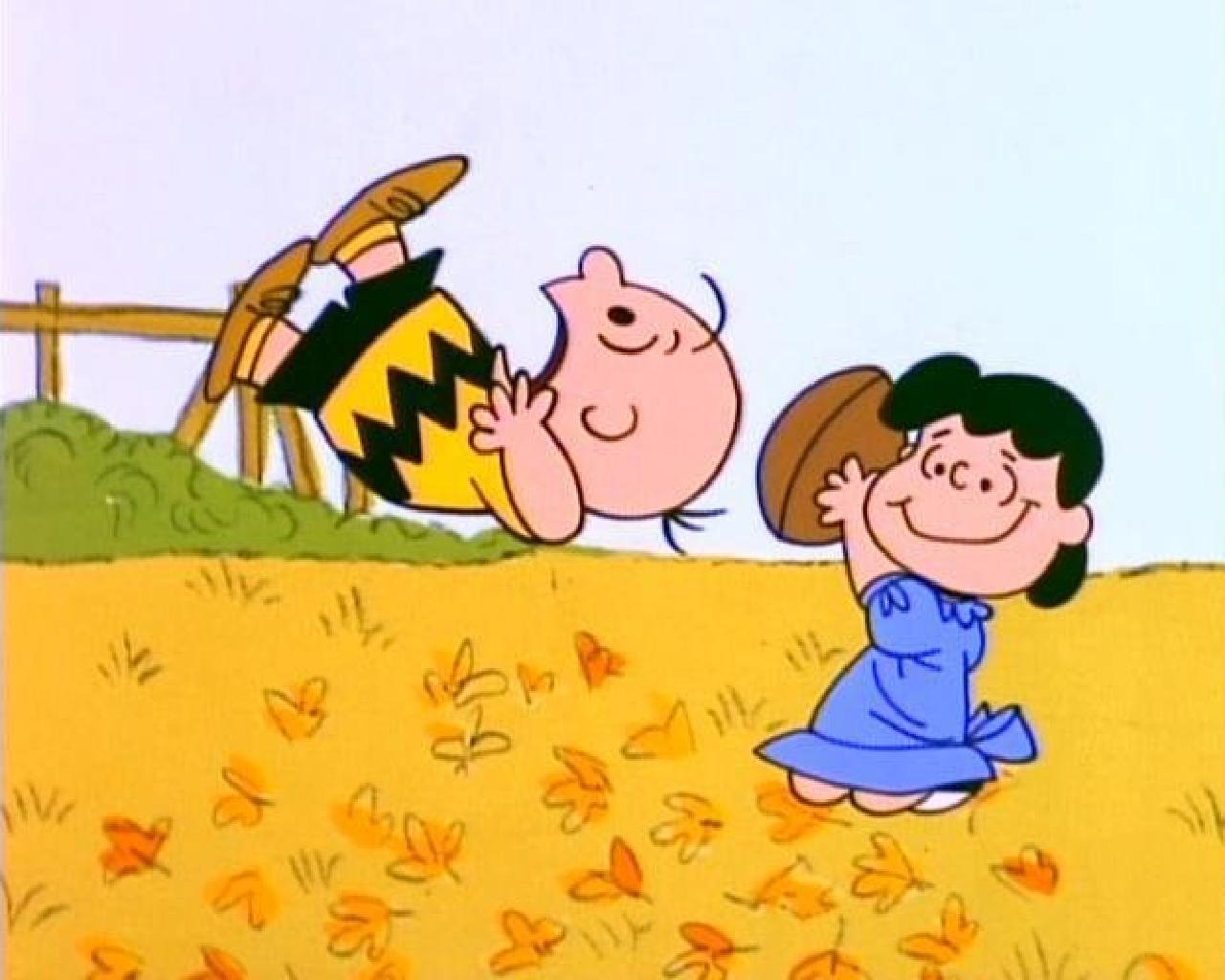
Let's End Lucy Republicans

"Lucy" Republicans can be identified by this:
No matter what they say about Leftists, when Push comes to Shove, they willingly support them against their own party.
Every time. 
Reminds me of this:

And, the Republican Party, of course, is Charlie Brown - eternally optimistic about the motivation of their colleagues.

Don't be like Charlie.

Even Lindsey Graham, the quintessential Charlie Brown for too many years, Hit the Wall.


He has largely stayed in his post-Bruce Banner, Hulk persona.

Don't be like Charlie. Be like Lindsey.

To Avert Responsibility, Collectivize!

     To him who hopes to deceive others for profit, the most attractive of all occupations is rhetorical tactician. Perhaps it always was that way. Demosthenes would probably say so; he was, after all, the man who framed rhetoric as the art of making “the worse appear the better cause.” Whatever the case, if your principal skill is lying, there’s no better job for you than rhetorical tactician for a political organization.

     That’s not to say that all politicians and political organizations are equally deceitful. Some tactics aren’t infinitely adaptable. That includes the one I have in mind this morning.

     Let’s start with an example: more exactly, a schematic of one. Imagine that you’ve signed on with some political group as a rhetorical tactician. Such a group will naturally prioritize protecting its members, its agenda, and its funding. At least, if it doesn’t have those things at the top of its priority list, it won’t last very long. But a political group’s focus will be on political action: i.e., on influencing the State, its agencies, and its agents toward support for the group’s agenda. That implies an orientation toward political incentives and governmental responses, usually as instantiated in law and executive policies.

     Now something unfortunate happens for your group: One of its more prominent members is caught doing something naughty. Moreover, the specifics of the naughtiness appear contrary to your group’s overt agenda. You’ve been assigned the task of detoxifying the event rhetorically: i.e., it’s your job to craft rhetoric that will frame what he did as something harmless or irrelevant to the group’s interests. What methods, in categorical terms, are available to you?

     There aren’t many choices. If there were a plausible alternate suspect to whom the deed could be ascribed, that would serve the purpose...but let’s postulate that your guy was caught red-handed. That excludes any possibility of attributing the offense to another individual. What’s left?

     Now now, let’s not always see the same hands!


     Just yesterday there was another mass shooting, this time in Philadelphia. The targets were Philadelphia police officers, six of whom were hit. The shooter eventually surrendered and is now in police custody. Media commentators immediately launched into rants about “white supremacy” having created “a climate of fear.”

     But the shooter is black. It takes some work to find a picture of him being apprehended, but they exist:

     Moreover, the shooter isn’t exactly unknown to the police. So how does this connect to “white supremacy” or “a climate of fear?”

     Yet this is what the Left’s mouthpieces do. They strain to redirect the responsibility for the crime from the individual onto some group, preferably a group hostile to the Left’s interests. They put a special effort into it when the individual is from one of the Left’s “mascot groups” (Thomas Sowell).

     It’s been going on for a long time. Ordinary people have begun to tune it out. Yet it will persist, because categorically speaking there’s no other way for the Left to deal with offenses committed by members of groups allied with them, or which they find politically useful.

     There are several such groups. American blacks. Illegal aliens. Muslims within America’s borders. (I refuse to call them “American Muslims” or “Muslim Americans,” as their creed commands them to deny their allegiance to anything but Islam and its ummah.) The media’s coverage of such persons’ misdeeds is invariably gentle; the political rhetoric wrapped around them is invariably deflective and collective.

     The consequences are coming home to roost.


     Collectivization begets collectivization. When the flacksters’ tactics become consistent enough and uniform enough to be widely recognized as what they are, those who recognize them are moved toward a “counter-collectivization” inimical to the flacksters’ agenda. We’ve already seen that identity groups will evoke counter-groups of other – usually opposed – identities. Groups that attempt to redirect responsibility for their miscreants onto “the police” or “society” have become noxious in the public mind. The reactions are unpleasant; they’re definitely the opposite of what a good person would wish.

     Ironically, the best counteraction to the presence of serious, disproportionate misbehavior within an identifiable demographic, regardless of whether it’s united by race, ethnicity, creed, occupation, or any other characteristic, is the institution of internal discipline. That is, the good people within the group would do best to deal with the criminals, disrupters, antisocials, et cetera internally, such that they can represent to those outside that “we know we have a problem, but we’re dealing with it, so please be patient with us.” For people cannot be prevented from seeing things in groups united by categorizing characteristics. We’re hard-wired to do so, and no amount of “re-education” will prevent it.

     The behavior of early Twentieth Century bootlegging gangs is instructive. Those gangs were often at war with one another. Blood often flowed freely during those contests...but only the blood of gang members. The bosses were scrupulous about not allowing gang-on-gang violence to involve outsiders. Outsiders were their customers; their good will had to be preserved. As for law enforcement, the bosses preferred bribery to the murder of policemen, wherever and whenever possible.

     The paramount need is to prevent government and its agents from taking a collectivist attitude toward the citizenry: regarding us not as individuals responsible solely for our own actions, but as members of groups that bear collective responsibility for whatever any of its members might do. That attitude, when inculcated in the State and its agents, invites preferential enforcement of the law at the very least. It can result in pogroms and “ethnic cleansings.” However, the prevailing political-rhetorical dynamic is in the direction of collectivization, and has been for some time.

     That dynamic must be countered and reversed. It might be inimical to the strategists of the Left – it certainly wouldn’t be good for the career prospects of their mouthpieces – but it’s one of the chief necessities of our time.

     More anon.

Wednesday, August 14, 2019

Out With the Religion-Lite, In With the Old

A church that had drifted far from Catholicism is brought back. AND, met with parishioner protests - right in the middle of Mass!

I commented on this, adding in some perspective from a recent trip to a Latin Mass - Solemn-High, at that!

Unacceptable By Association

     We tend to judge a man, at least in part, by the company he keeps. The practice goes all the way back to Eden. The Pharisees tried to use it against Jesus, for His willingness to associate with publicans and sinners. It’s not entirely unfair or nonsensical. But it has consequences, and not all of them are good ones.

     Granted, proximity is sometimes illusory. The “six degrees of separation” effect can be used to link persons who know nothing about one another. But an individual’s voluntary associations are and have always been considered an indication of what that individual considers acceptable in others. In the past, this has been exploited by both the Left and the Right. Today it’s a major tactic of the Left in its war on the rights of American citizens.

     The contemporary (i.e., totalitarian) Left uses the practice to its advantage by polluting groups of Right-inclined persons with fakers who openly espouse unacceptable views. Fora hospitable to the Right are their principal targets. Once such a forum opens for business, the Left details trolls to join it and to spout vileness: politicized racial, ethnic, and sexual bigotry, calls for mass murder, “entertainment” of the lowest kinds of porn and violence. Leftist activists then immediately denounce that forum as a place where only the unacceptable would go.

     I’ve witnessed this tactic at several recently-opened "social media" sites dedicated to free expression:

     The pattern has been consistent. The responses to it have not.

     The tactic has an in-the-flesh equivalent that’s becoming more worrisome. Historically, the technique involved inserting “supporters” into a political rally that others would deem unacceptable for their other connections: e.g., “Satanists for Trump.” However, AntiFa, the Democrat Party’s Brownshirts, has been “overheard” talking about infiltrating free-speech demonstrations so that when violence erupts, they can make it look as if the free-speech advocates started it.

     As usual, the tactic is oriented toward persuading unaligned Americans that “you don’t want to be part of that crowd.” And unfortunately, it works.


     Every era – every moment — is “a time of transition.” The “from” and the “to” are often discernible only long afterward. Moreover, whether the change was for good or for ill can remain questionable for decades.

     The November 2016 election indicated that a great many Americans had finally become sufficiently disenchanted with the political elite to rebel against it, at least at the ballot box. Yet we cannot know with certainty whether that disenchantment will endure. The Left is putting forth all its forces in the attempt to make the Trump Administration and its agenda look unacceptable to the unaligned. Indeed, the “Russian collusion” hoax was aimed at no other result. The recent attempt to tie President Trump to the late Jeffrey Epstein was a follow-up, albeit a weak and easily refuted one.

     The hot-button issues of the moment are illegal immigration to the United States and the right to keep and bear arms. (Yes, there are other important issues; these are the ones that currently command the greater part of the national discourse.) Look for the Left to use its unacceptable-by-association tactic on both. In the case of the influx of illegal aliens over our southern border, the approach will be to color it as racial and / or ethnic hatred. In the case of the right to keep and bear arms, gun-rights advocates will be juxtaposed with mass murderers and advocates thereof. Ordinary decent Americans who lack firm opinions on those matters will be asked, subtly and sotto voce, whether they’d be happy about enabling the aspirations of such persons.

     We need a counter-tactic that can nullify the effect of those thrusts. At the moment we don’t have one. Thoughts?

Short history of the last 100+ years.

Geez, total fail. CHS dude get a clue man. PROGRESSIVES own this suck and there is nothing conservative [can do] about it. "Neocons" is a misdirection word soft minded people use.

There are ZERO true founding father type constitutional conservatives anywhere in the US FEDGOV. Progressives took over everywhere about 1900 give or take and it's been downhill ever since. They have illegally grown the state in violation of the Constitution into the monster of tyranny we have now.

Founding Fathers America=no standing army on foreign soil, no intervention in other nations affairs, no income tax on citizens. NO alphabet agencies, no pencil neck poindexter government parasites looking over [anyone's] shoulders or telling anyone what they can or can't do.

Progressives broke the law to grow the state in America in violation of the [Constitution].[1]

The Bible speaks of tithing 1/10 of your income. Now some people pay more than 50% of what they earn in taxes and get to watch griters, morons, and their enemies decide on how their taxes should be spent.

Our country today operates on mere vestiges of our old freedoms. Progressives/ultra leftists are just getting warmed up to strip us of the remainder of our essential rights.

Notes
[1] Comment by Grimaldus on "Epstein Is The Deep State Civil War's First High-Profile Casualty." By Charles Hugh Smith, ZeroHedge, 8/12/19.